PARCHMENT & TORN-EDGE IMAGE EFFECTS
Illuminator
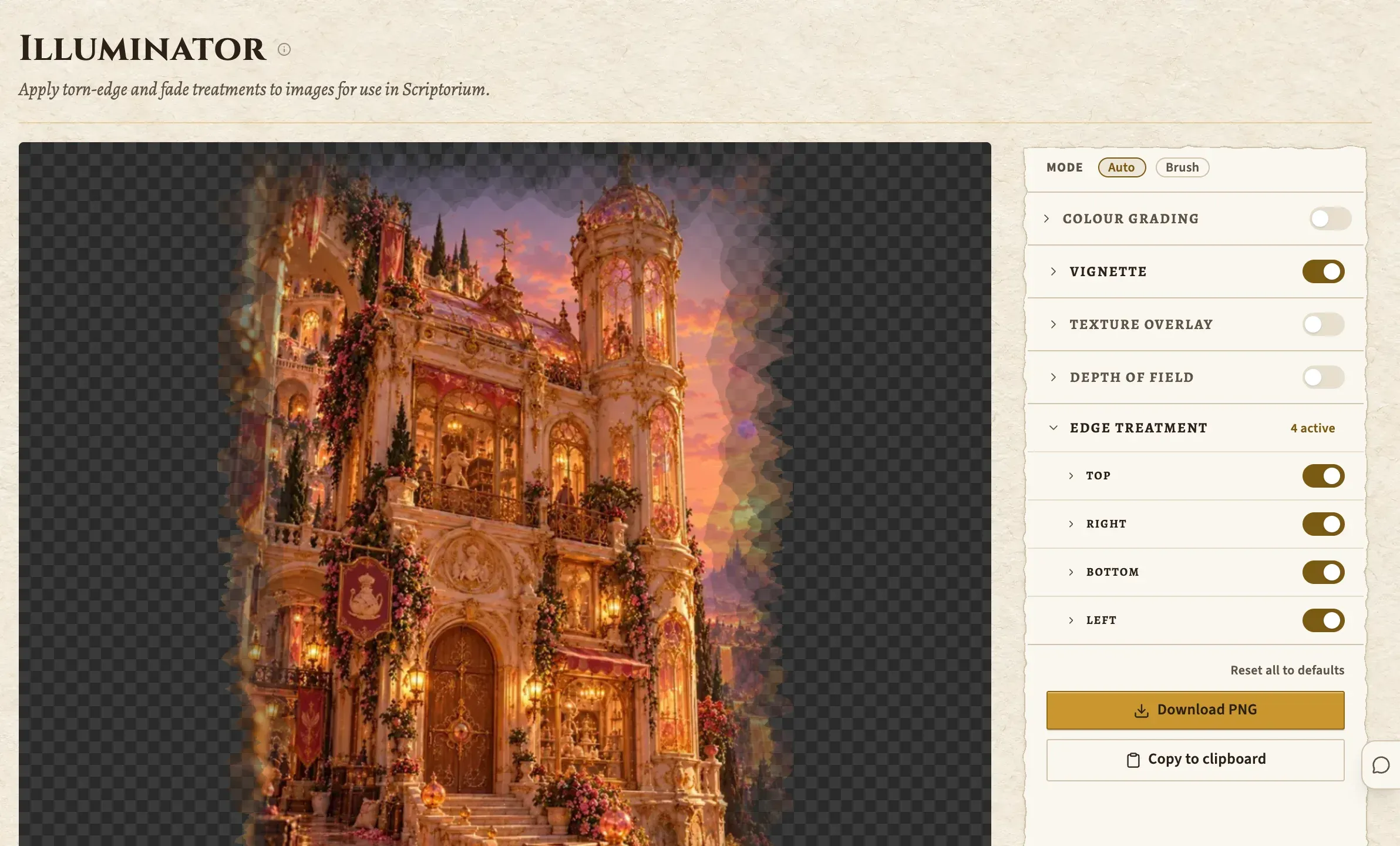
A small image editor with an outsized effect on how your handouts land. Give a picture torn edges, a vignette, colour grading, a paper texture or a soft depth of field, then download it or send it to a Scriptorium document, where it looks like part of the page.
THE PROP PROBLEM
You handed them a letter from a dying king. It was printed on A4 by an office printer.
Physical handouts are one of the highest-return things you can do at a table. A letter, a torn journal page, a map fragment. A player holding an object engages with it in a way that no amount of read-aloud text achieves.
And then you print it, and it comes out as crisp black text on bright white paper with perfectly straight edges, and it looks exactly like what it is: a document from a laptop. The illusion doesn't survive the paper.
Illuminator is the thirty seconds that fixes that. Torn edges, parchment tone, age. Same content, entirely different object.
 AI-generated
What it does
- Torn edges
- The ragged border that turns a rectangle into something that was torn out of a book.
- Parchment treatment
- Age, tone and texture, so a clean digital image stops looking like a clean digital image.
- Any image
- Maps, portraits, letters, a photo of your own handwriting. It doesn't care where it came from.
- Straight into Scriptorium
- Illuminated images drop into homebrew documents as illustrations that match the page.
- For handouts
- The main event: a prop your players hold that doesn't look like it came off an office printer.
- Small tool, large effect
- About thirty seconds of work for a disproportionate change in how a handout lands.
A CORRECTION WE OWE THIS PAGE
Illuminator is not the map tool. We used to say it was.
Until recently this site described Illuminator as "prep battlegrid maps without the VTT baggage". That was our own copy, and it was wrong about our own product: Cartographer paints battle maps. Illuminator makes images look like pages.
The names are adjacent enough that the mix-up was easy, and it survived long enough to reach a planning document. Both tools are good; they simply do unrelated things, and it seemed worth saying so plainly on the page of the one that got misdescribed.
Questions a DM would actually ask
Isn't this a bit of a small feature?
Yes, and it's on this page precisely because covering everything is the point. It's thirty seconds of work with a genuinely disproportionate effect on how a prop lands. Small tools that do one thing well are allowed to exist.
Hang on, isn't Illuminator the map tool?
No, and we had this wrong on our own landing page until recently. Cartographer paints battle maps and dungeon layouts. Illuminator applies torn-edge and parchment treatments to images. Easy to confuse, entirely different jobs.
What do people use it for most?
Handouts. A letter from an NPC, a torn page from a journal, a fragment of a map: printed with an illuminated treatment, it reads as an object from the world rather than a printout of a document.
Does it work with maps?
Very well, as it happens. A regional map with torn edges and parchment ageing looks like something a character could plausibly be carrying, which is the effect you usually want for a map the party has been given, as opposed to a battle map you fight on.
Can I use it on images from elsewhere?
Yes. It doesn't care whether an image was generated, uploaded, commissioned or scanned. Bring in art you already own and give it the same treatment as everything else.
Does it need AI?
No. It's an image treatment, not a generator, so it keeps working exactly the same with the AI switch off.
Give the next handout torn edges.
Thirty seconds. Then watch someone at the table handle it more carefully than they handled the last one.
Open your grimoire for freeNo card. No beta waitlist. Always free for your players.
In the same grimoire
Encounter Runner
Initiative, HP, conditions, factions and mid-combat spawning. The TPK is on you; the bookkeeping is on us.
Card Forge
Printable trading-card and tarot-sized cards for NPCs, monsters, items and spells. Hand your players something real.
Scriptorium
A homebrew editor styled like the 2024 PHB, with the stat blocks and page furniture already built.