
D&D NPC GENERATOR & MANAGER
NPCs
Every person in your world: who they are, who they know, what they're hiding, what they're carrying, and what the party thinks of them. Keep the cast ready when the party circles back.
THE MODULE THAT GETS OPENED MOST
Your world is not a map. It's about forty people.
Ask a player what they remember about a campaign and they will not describe the geography. They'll tell you about the innkeeper who wouldn't stop talking, the guard captain they never trusted, and the marsh-witch who is still owed money. The cast is the campaign.
Which is why the NPC list is the screen most DMs have open most of the time, and why keeping it in a document is such a specific kind of painful. The party walks into a building and asks about someone you invented in session four, and you have eight seconds to find out who they are, who they know, and what you decided they were hiding.
So this is built for that eight seconds. Quick facts at the top. Relationships one click away. Secrets behind your screen. And the note your player wrote about them, so you find out what the party actually thinks.
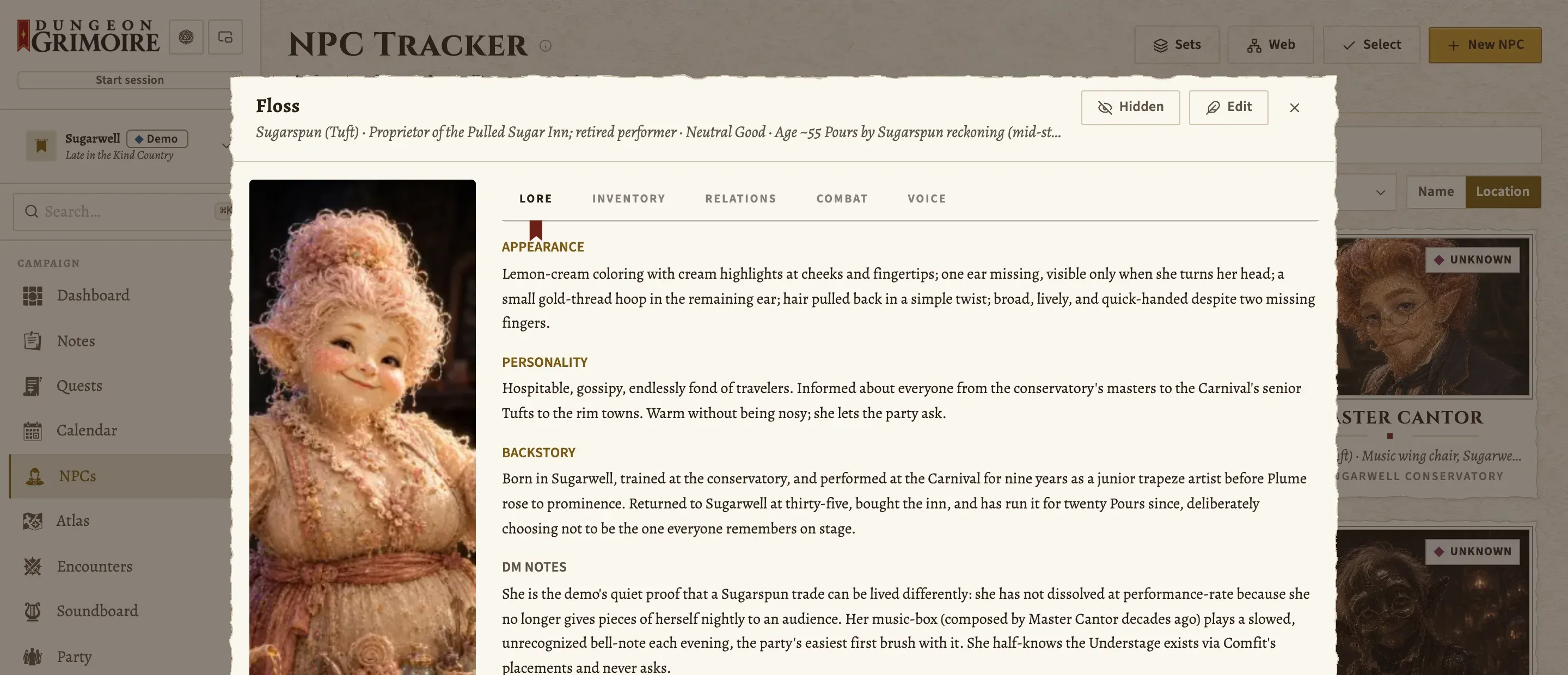
What an NPC holds
- Identity
- Name, role, look, voice: the handful of things you need in the two seconds before you start talking as them.
- Quick facts
- The three things you'd want on an index card, at the top, where your eye lands first.
- Relationships
- Who they know and how. Filterable, so "who does the party know in this town" is a question with an answer.
- The relationship web
- The whole cast as a graph. This is where you notice the plot you'd accidentally written.
- Secrets
- What they're hiding, kept DM-side, revealed on your say-so and not a moment earlier.
- Inventory
- What they're carrying, which matters the moment the party decides to rob them.
- Portraits & disguises
- A face, and a second face for when they're being somebody else.
- Player notes
- What your party wrote about them, visible to you. Occasionally humbling.
- Sets
- Group NPCs into sets (a guild, a family, a crew) and bring the whole lot into a campaign at once.
THE ONE NOBODY EXPECTS
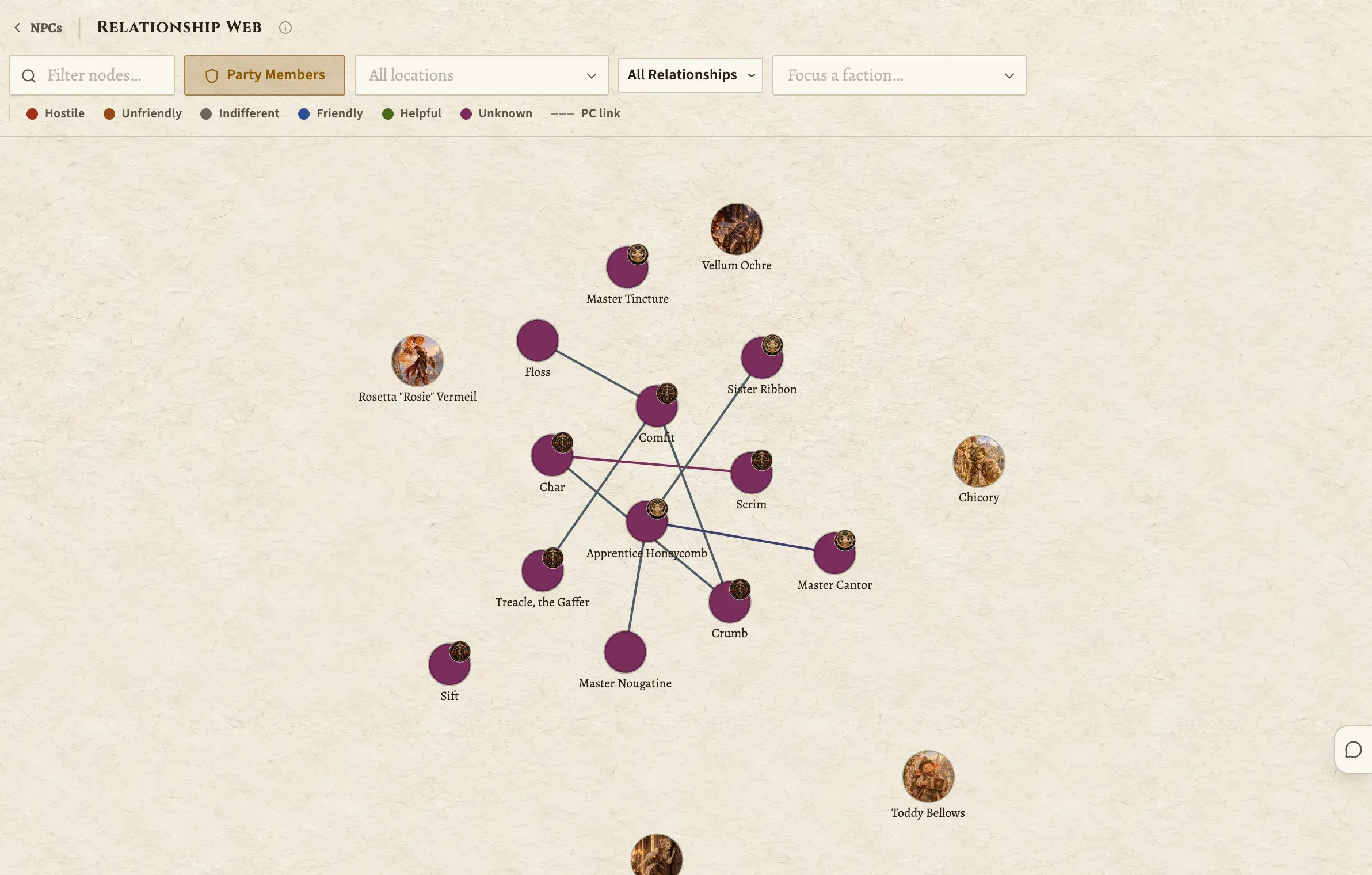
The relationship web will show you a plot you didn't know you'd written.
You add relationships one at a time, without ceremony. She's his sister. He owes the guild money. The guild's quartermaster drinks at the inn the party keeps using. Each one takes four seconds and feels like housekeeping.
Then you open the web view and see the whole cast as a graph, and there is a cluster you didn't design, with an obvious central figure you'd been treating as a bit-part, connected to three threads the party has already pulled on.
Every DM who has used it has had that moment. It is worth the price of the relationship fields on its own.
AND THE PARTY'S HALF
They keep their own record. You get to read it.
Your players see the people they've met in their portal: a scrollable A–Z of the cast, with notes they wrote themselves at the time. Private ones only they see, party ones the whole table shares.
You can read the party notes. This is occasionally very funny and occasionally very useful: you find out that the NPC you built as a minor merchant has been treated as a major suspect for three sessions, and you get to decide whether they were right all along.
Questions a DM would actually ask
Can it generate NPCs, or do I write them all?
Both, and the generator is there for the specific emergency it's good at: a player has just asked the name of a shopkeeper you did not prepare. Write the ones who matter, generate the ones who didn't matter until nine seconds ago. With AI switched off, the generator disappears and everything else works unchanged.
What's the relationship web?
A graph view of your whole cast and how they connect. It's genuinely the most useful accidental feature in the app. You build it one relationship at a time without thinking, then look at the web and find a faction, a rivalry or a whole plot you'd assembled without noticing.
Can I keep secrets from my players?
Yes, and that's the default. An NPC has what the party knows and what's true, and the second is DM-only until you reveal it. The disguise portrait works the same way: show them the face they've seen.
Do my players see the NPCs they've met?
They get a People tab listing everyone they've actually met, A–Z, with their own private and party notes attached. It's the single thing players say saves the most session time. The marsh-witch from six months ago comes back with her name and their own note about her already attached.
What are NPC sets?
A way to group NPCs that belong together (a thieves' guild, a noble family, a ship's crew) and import them as a unit. Handy when you're reusing a cast across campaigns, or dropping a prepared faction into a game.
How many NPCs do I get on the free tier?
20, a decent cast of people who matter. Pro removes the cap, and the number of NPCs in a long campaign is usually the first limit a DM actually notices.
Can I print them?
Yes. Card Forge turns any NPC into a printable trading-card or tarot-sized card, portrait and all. Handing a player the card for someone they just met does a lot of work for very little effort.
Put the cast somewhere you can find them in eight seconds.
20 NPCs on the free tier. Start with the four people your party keeps going back to.
Open your grimoire for freeNo card. No beta waitlist. Always free for your players.
In the same grimoire
Bestiary
Open5e's SRD monsters, a builder for your own, and a reveal sheet for showing players exactly what you want.
Spellbook
The SRD spell list plus your own homebrew, with a level advisor for when you're not sure what you've built.
Character Sheet
Export a filled-in, illustrated character sheet for any party member. Paper, for the table that likes paper.