
BATTLE MAP MAKER
Cartographer
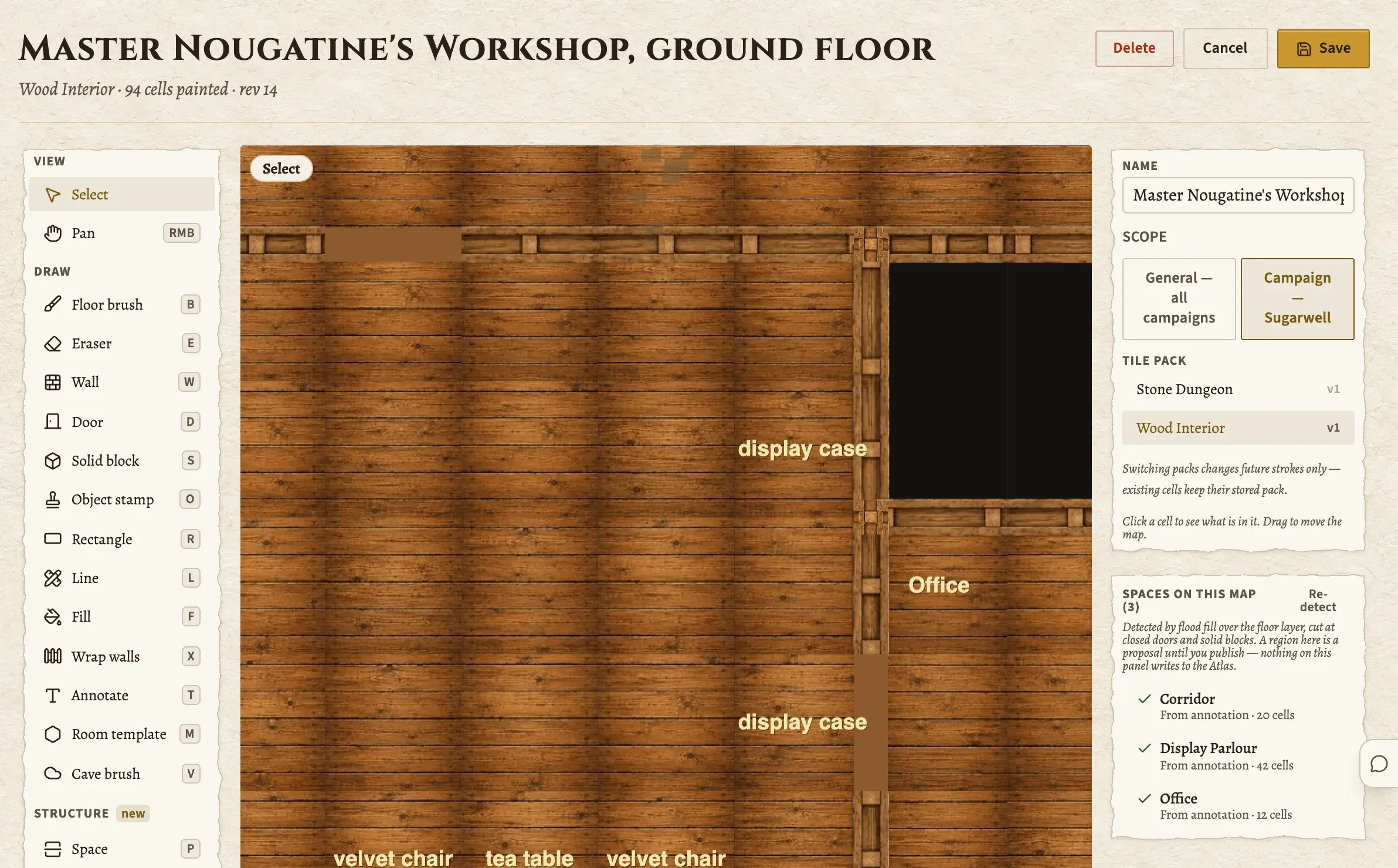
Paint a battle map or a dungeon layout in the browser, then run the fight on it. No VTT account, no asset store, no forty-minute setup for a room the party leaves in nine minutes.
THE FORTY-MINUTE ROOM
You spent longer building the room than they spent in it.
Everyone who has tried to prep a map in a virtual tabletop knows the specific sting of it: forty minutes assembling a tavern out of tilesets, lighting it, walling it, and then watching the party ask one question at the bar and leave.
The problem isn't that maps are bad. Position matters: flanking, difficult terrain, whether the cleric can reach the fighter. A shared picture settles arguments that words don't. The problem is that the tools were built for games played entirely online, and they charge you online-game setup costs for an in-person fight.
Cartographer is the smaller thing: paint a layout, put it on the screen, run the encounter on it. Nine minutes of prep for nine minutes of fight.
What it's for
- Paint, don't place
- Draw the room rather than hunting an asset library for a tile that's nearly the right shape.
- Dungeon layouts
- Corridors, chambers and the awkward diagonal bit, laid out at the scale a fight happens on.
- Straight into a fight
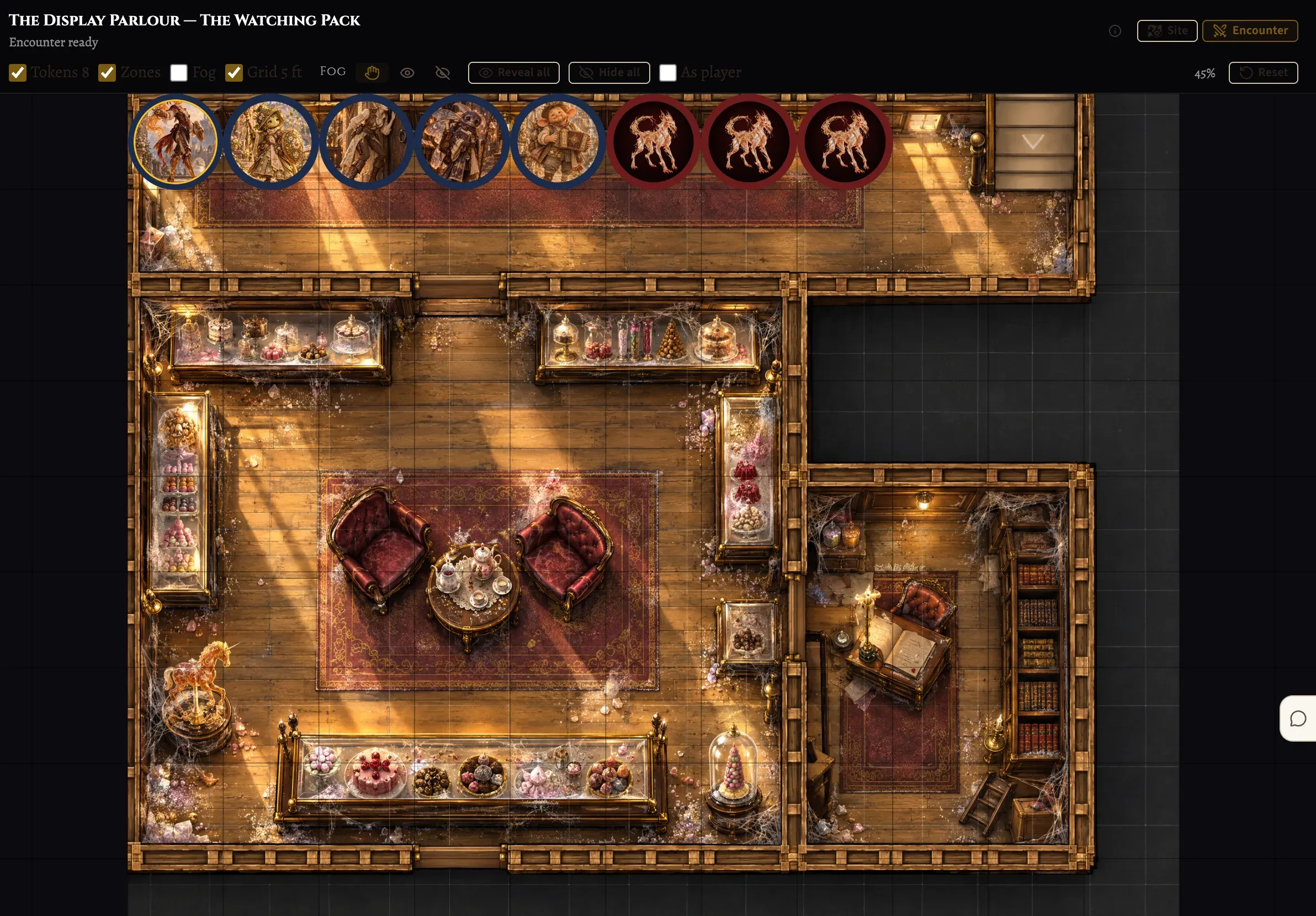
- A finished map is available to an encounter's map view, tokens and all.
- Fog of war
- Paint back the dark as the party moves. Nobody sees the room with the dragon in it early.
- Saved per campaign
- Maps live with the campaign that needs them, not in a downloads folder called "map final v3".
- Or bring your own
- Already own a map you love? Use that instead. Nothing here insists you draw your own.
THE HANDOFF
The map's real job starts when the fight does.
A map that lives in a folder is a nice drawing. A map that an encounter can open, with the initiative order already on it as tokens and a fog layer you paint back as the party advances, is a tool.
That handoff is the reason to draw it here rather than anywhere else. Everything you build in Cartographer is available to the Encounter Runner's map view, in the same campaign, without an export step in between.
 AI-generated
Questions a DM would actually ask
Is this a virtual tabletop?
No, and we chose that. There is no player-side grid to log into, no per-seat licence, no expectation that your table is five webcams. It's a map you can put on a screen in the middle of a real table, or share however you already share things.
How is this different from the big map makers?
The dedicated map tools are more powerful and always will be. That's their whole product. The trade here is integration: this map is attached to the campaign, and an encounter can open it with the initiative order already on it. No export, no import, no filename convention.
Do I need art assets?
No. You paint the layout rather than assembling it from a tileset, which means no asset store, no pack to buy, and no forty minutes lost to browsing dungeon-floor textures at midnight.
Can I use a map I already have?
Yes. If you've bought or drawn a map you like, drop it into the encounter's map view and run on that. Cartographer is for the nights when you haven't got one.
What is Illuminator, then?
A different tool that gets confused with this one, including by our own landing page until recently. Illuminator applies torn-edge and parchment treatments to an image so it looks like a page from a book. Cartographer draws the map. Different jobs.
Does the party see the map?
Only where you point the screen. Fog of war means you can reveal the dungeon a room at a time even when everyone's looking at the same monitor.
Draw the room. Run the fight. Go to bed.
Cartographer is in the free tier. So is the encounter it feeds into.
Open your grimoire for freeNo card. No beta waitlist. Always free for your players.
In the same grimoire
Atlas
Realms, cities and dungeons in a hierarchy that goes from continent to the stool in the corner of the tavern.
Character Codex
Species, backgrounds, classes, archetypes and abilities. Yours, and usable by your players at character creation.
Calendars
Nine official settings' calendars built in, from Faerûn and Eberron to Krynn and Barovia. Or forge your own.