
D&D AMBIENCE & SOUNDBOARD
Soundboard
Ambience beds, one-shot effects and your own Spotify playlists, wired to buttons you can hit without looking away from the table. It happens to come bundled with everything else.
THE SECOND-TAB TAX
Nobody wants a soundboard. They want the tavern to sound like a tavern.
Ambience is the cheapest atmosphere in the hobby. Thirty seconds of rain and a fire crackling and your players lower their voices without being asked. It costs you nothing and it works every single time.
The reason most tables don't run it isn't taste. It's logistics. It lives in another tab, or another app, or another subscription, and during the session you are already juggling the encounter, the notes and four people talking at once. The third thing you have to alt-tab to is the thing that quietly stops happening.
So the soundboard is in here, with the rest of it. Same login, same campaign, same tab. Not a second app, not a second subscription: a board that's already open when the moment arrives.
IT ARRIVES STOCKED
The empty board was the actual problem.
A soundboard with nothing on it is not a feature, it's homework. The tools that work are the ones you can open on the night and use, and every minute spent sourcing a rain loop is a minute you weren't prepping the session.
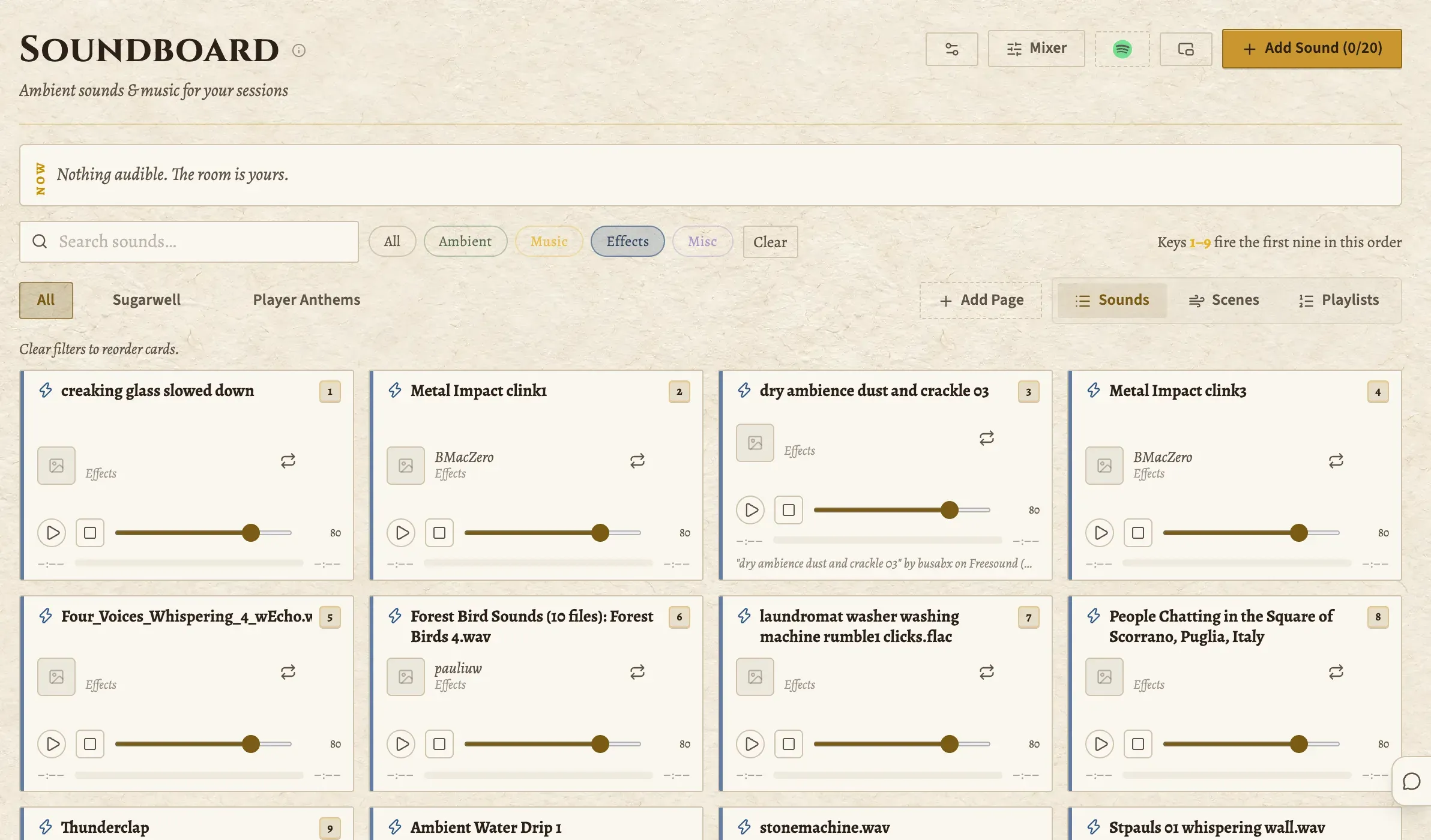
So it comes with about eight hundred sounds on it, all Creative Commons, all hosted by us, and seven scenes already built out of them: a tavern with a fire and mugs, a storm, a dungeon that drips, a night camp, a coast, a forest, a town square. Each one is tagged, so an encounter or a location can drive it before you've labelled anything yourself.
None of it is PRO-only and none of it counts against the free tier's sound limit. Where a sound's licence asks for credit, the credit travels with it onto your board and onto a credits page in the app. You never have to keep track of that yourself.
What's on the board
- Ambience beds
- The long ones that sit under a scene (tavern, forest, storm, dungeon drip) that loop without you thinking about them. The loop point is covered, so there's no click coming round every ninety seconds.
- One-shot effects
- Door, thunderclap, wolf howl, sword. Hit it on the beat and watch a table jump. The music ducks underneath while it lands.
- Scenes, not a stack of loops
- Every layer has its own level, and a layer can fire on its own schedule instead of looping. A mug that clatters somewhere on the left every forty seconds or so, never quite the same, is what stops a room sounding like a recording. Run two scenes at once if you want rain over the tavern.
- It takes its cue from the game
- Label a playlist "battle" and give the encounter the same theme. Starting combat brings the music up on its own, and ending it puts back what was playing before. Locations do the same for ambience.
- Fire it by name
- One shortcut from anywhere in the app, three letters, enter. Number keys fire the first nine on the board. You don't have to be on the soundboard, or looking at it.
- Spotify
- Connect your account and drive your own playlists from the same board. Your combat playlist, your rules.
- Per-campaign
- The board belongs to the campaign, so the pirate game and the gothic horror game don't share a soundscape.
- It ships with sounds already on it
- Eight hundred Creative Commons sounds we host ourselves, and seven ready-made scenes (a tavern, a storm, a dungeon, a night camp), so the board does something on the first evening. Free on every tier, and none of it counts against your sound limit.
- And a bigger library to search
- For anything we don't already have, search Freesound without leaving the app. We filter to the licences that are genuinely free to use and keep the credit attached to the sound.
SPOTIFY, SPECIFICALLY
You already made the combat playlist. Use it.
Somewhere in your Spotify account is a playlist called something like "BATTLE" that you have been curating for four years. It is better than anything we would ship, because you made it for your table.
Connect the account and drive it from the same board as the ambience and the effects. The music you already own, the sounds you've put on the board, one screen, no alt-tabbing to a different application in the middle of a dramatic pause.
IT TAKES ITS CUE
The music should already be up by the time you say roll initiative.
The trouble with a soundboard is that it needs a hand. Something happens at the table and you reach for the mouse, and by the time you've found the track the moment you were scoring has already gone past.
So give the encounter a theme, and label a playlist to match. Starting combat brings the music up on its own and ending it puts back whatever was playing before. Label three playlists "battle" and each fight picks one, so the fourth goblin ambush of the campaign doesn't open with the track your players have started humming. Locations work the same way for ambience, which means the dungeon keeps rumbling underneath the fight instead of being replaced by it.
None of it fires unless you set it up, and a theme that matches nothing leaves your audio exactly where it is. The board never starts something you didn't ask for, which is the only way a feature like this survives its first wrong guess in front of six people.
Questions a DM would actually ask
Do I need a Spotify subscription?
No. The board comes with eight hundred sounds and seven scenes already on it, and you can add more by searching the free library from inside the app, uploading your own, or pointing it at a URL you already host. Spotify is an optional extra for driving playlists you already own from the same screen.
Is this really as good as the paid standalone tools?
On what it does, yes. It layers scenes, fires one-shots on their own schedule so a room doesn't sound like a recording, ducks the music underneath them, crossfades between tracks, loops without a seam, and takes its cue from the encounter you just started. It also arrives stocked now (eight hundred sounds and seven built scenes), so there's no empty-board evening to get through first. Where they're still ahead is depth of library: a few hundred finished ambiences beats our seven, and we'd rather say so than pretend otherwise. The difference in shape hasn't changed either. A dedicated audio tool charges audio-tool money for audio alone; this is one module of a toolset you already pay a single subscription for, and it's on the free tier as well.
Can I use my own audio files?
Yes. Drag your own files in and they sit on the board next to everything else, though uploading is a PRO feature. On any tier you can point the board at a URL you already host, and connect Spotify to drive music you already own.
Does it work for online games too?
Yes, if you turn it on. Share the session and the music you're playing appears in the player portal, where each of your players joins on their own device and sets their own volume. It's off by default and it resets every session, because most tables are in one room and five phones playing the same track is worse than none of them. It doesn't go into your voice call: your players hear it in the app, not through Discord.
Will it keep playing while I use the rest of the app?
Yes. The soundboard is a view inside the same app, so navigating to your encounter or your notes doesn't stop the audio. That's rather the point of it not being a separate tab.
Is the soundboard free?
Yes, on the free DM tier along with everything else, and so is the library that comes with it. The bundled sounds and scenes don't count against your sound limit either, because giving you a library and then charging you room to keep it would be a strange sort of gift. Players never pay for anything at all.
Run one session with rain under it.
It's free, it's already in there, and it takes about ninety seconds to set up. Then see whether your table notices.
Open your grimoire for freeNo card. No beta waitlist. Always free for your players.
In the same grimoire
Player Portal
Character sheets, inventory, spells, notes and the whole cast. Free for every player, on every plan, forever.
Cartographer
Paint battle maps and dungeon layouts, then run an encounter straight on top of them.
Atlas
Realms, cities and dungeons in a hierarchy that goes from continent to the stool in the corner of the tavern.