
FREE D&D PLAYER APP
Player Portal
Your players get their own app: character sheet, inventory, spellbook, the full cast of NPCs they've met, a shared journal and private notes on everything. It is free for them. It stays free for them.
THE PART EVERYONE GETS WRONG
Charging the table per seat is how good tools die.
Here is the standard model: the DM finds a tool they like, and then has to go and ask four adults to each pay a monthly fee to use it. One of them says yes immediately, two say they'll do it later, and one has strong opinions about subscriptions. The tool quietly stops being used by the group.
Every DM has run this exact negotiation and lost it. So we took it off the table: the Player Portal is free for everyone at your table, on every plan, permanently. Not a trial, not a reduced tier, not free-until-we-raise-a-round.
You pay, if you ever pay, for DM-side capacity. Your players pay nothing, because a player who has to be convinced to install something is a player who won't open it in week three.
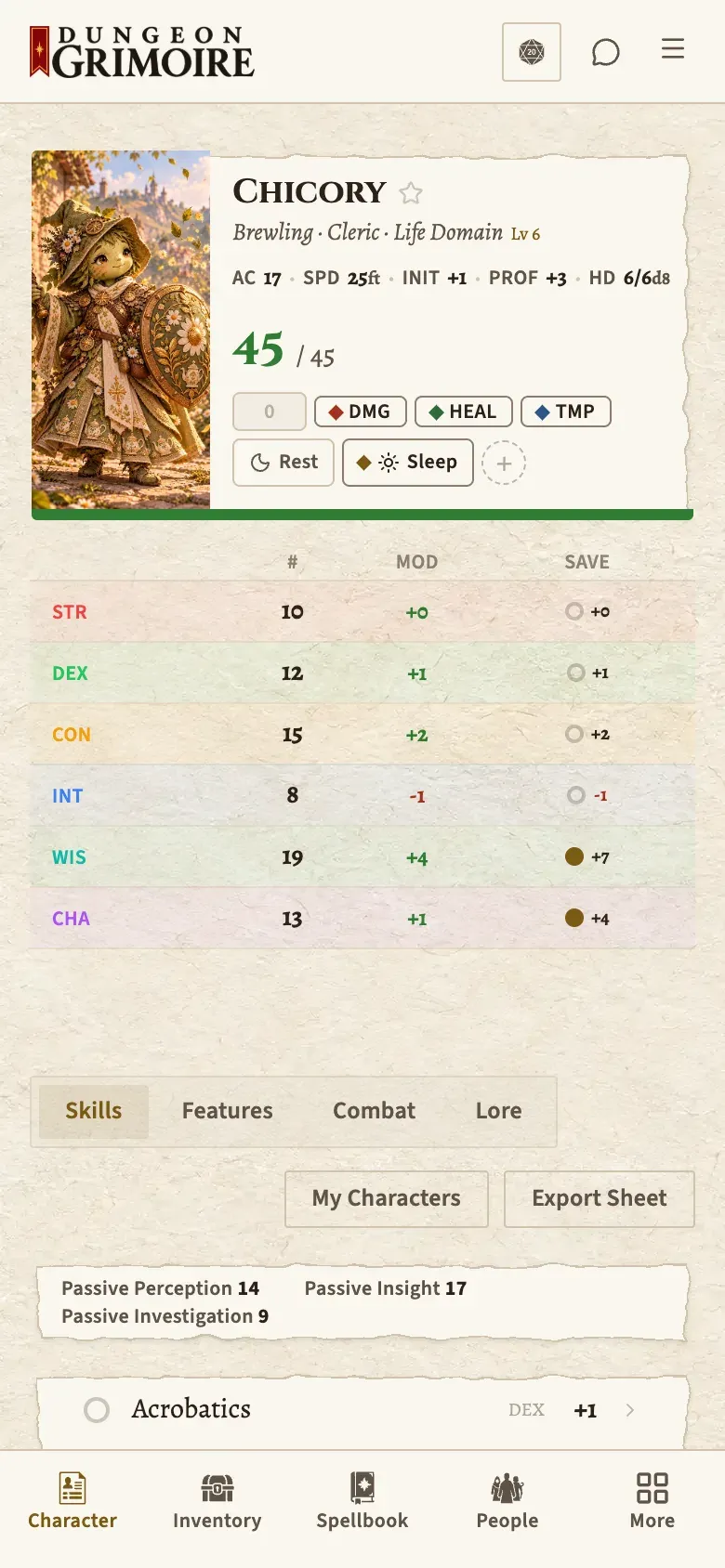
What your players get
- Character
- The full sheet, plus a creation wizard that walks from species and background through class, abilities and starting equipment.
- Inventory
- A paper doll for equipped gear, a coin purse that makes its own change, and carry weight that adds itself up.
- Spellbook
- Prepared and known spells, including whatever custom ones the DM wrote into the campaign.
- People
- Every NPC they've met, A–Z, with their own notes attached. Six months later, this is the tab that saves the session.
- Journal
- The quest log and session notes: what's open, who gave it, and what the party swore they'd come back for.
- Atlas & Bestiary
- The places they've been and the things they've fought, as the party knows them, not as you know them.
- Factions
- Who the party is in good standing with, and who is definitely still annoyed about the warehouse.
- Calendar
- The in-game date, in the setting's own calendar, so "how long until the festival" has an answer.
- Workshop & Interlude
- Crafting and downtime, if the DM has those rules switched on. Players drive their own projects.
THE ONE THAT WINS PEOPLE OVER
Six months later. Five days in-game. One note that saves the session.
Your party met a marsh-witch half a year ago. In the fiction it was five days. Nobody remembers her name, what she wanted, or why Cassia is holding an IOU with her handwriting on it, and you are about to spend eleven minutes reconstructing it out loud.
Or: a player opens People, scrolls to Old Maggie in a list of everyone they've ever met, and reads the note they wrote themselves at the time. "Do NOT give her money. She never pays it back. Ever."
That is the whole feature. A player can pin a note to any NPC, location, item, quest or session, private to them or shared with the party. It costs them nothing and it saves you the eleven minutes.
AND IT PULLS THE DM IN
Half our DMs arrived as somebody's player.
Worth saying plainly, because it's the actual strategy: a player who has used the portal for a campaign and then decides to run their own game already knows what the tool does. They've been inside it for months. They didn't watch a demo.
Which is why the portal isn't a stripped-down teaser with an upgrade prompt in the corner. It's a good app that happens to be free, because the version of this that works is the one where your players actually like it.
Questions a DM would actually ask
Do my players have to pay?
No. Ever. The Player Portal is free for everyone at your table, no matter which plan you're on. What you pay for is DM-side capacity. Your players just show up and play.
Do they need an account?
They join through an invite link you send them. That gives them a login of their own, which is what makes their private notes actually private and lets them come back on their phone between sessions.
Can they see things I haven't shown them?
No. The portal renders the party's view of the world: the NPCs they've met, the places they've been, the quests they know about. What's behind your screen stays behind your screen until you reveal it.
What are private notes versus party notes?
Both. A player can pin a private note only they can see, or a party note the whole table shares, on any NPC, location, item, quest or session. The suspicious cleric gets one of each, generally.
Does it work on a phone?
Yes, and that's mostly where it gets used. It's installable as an app from the browser, and the navigation adapts down to the tabs that fit. Players check it on the bus; that is a real and good thing.
Can a player make their character in it?
Yes, there's a full creation wizard: basics, species, background, class, abilities, equipment. It'll offer your campaign's custom species and backgrounds from the Character Codex alongside the standard ones.
What if my players don't want another app?
Then don't make them use it. Everything in Grimoire works with a DM and a table of people holding paper. The portal is an offer, not a requirement, and the free tier means the offer costs them nothing to try.
What happens if I stop paying for Pro?
Your players keep their portal. That's the whole promise: their access is never the lever. You'd hit the DM-side content caps again, not them.
Send one invite link and find out.
Free for them, free to start for you. The worst case is your party has a shared quest log they didn't have last week.
Open your grimoire for freeNo card. No beta waitlist. Always free for your players.
In the same grimoire
Cartographer
Paint battle maps and dungeon layouts, then run an encounter straight on top of them.
Atlas
Realms, cities and dungeons in a hierarchy that goes from continent to the stool in the corner of the tavern.
Character Codex
Species, backgrounds, classes, archetypes and abilities. Yours, and usable by your players at character creation.