
D&D WORLDBUILDING & LOCATIONS
Atlas
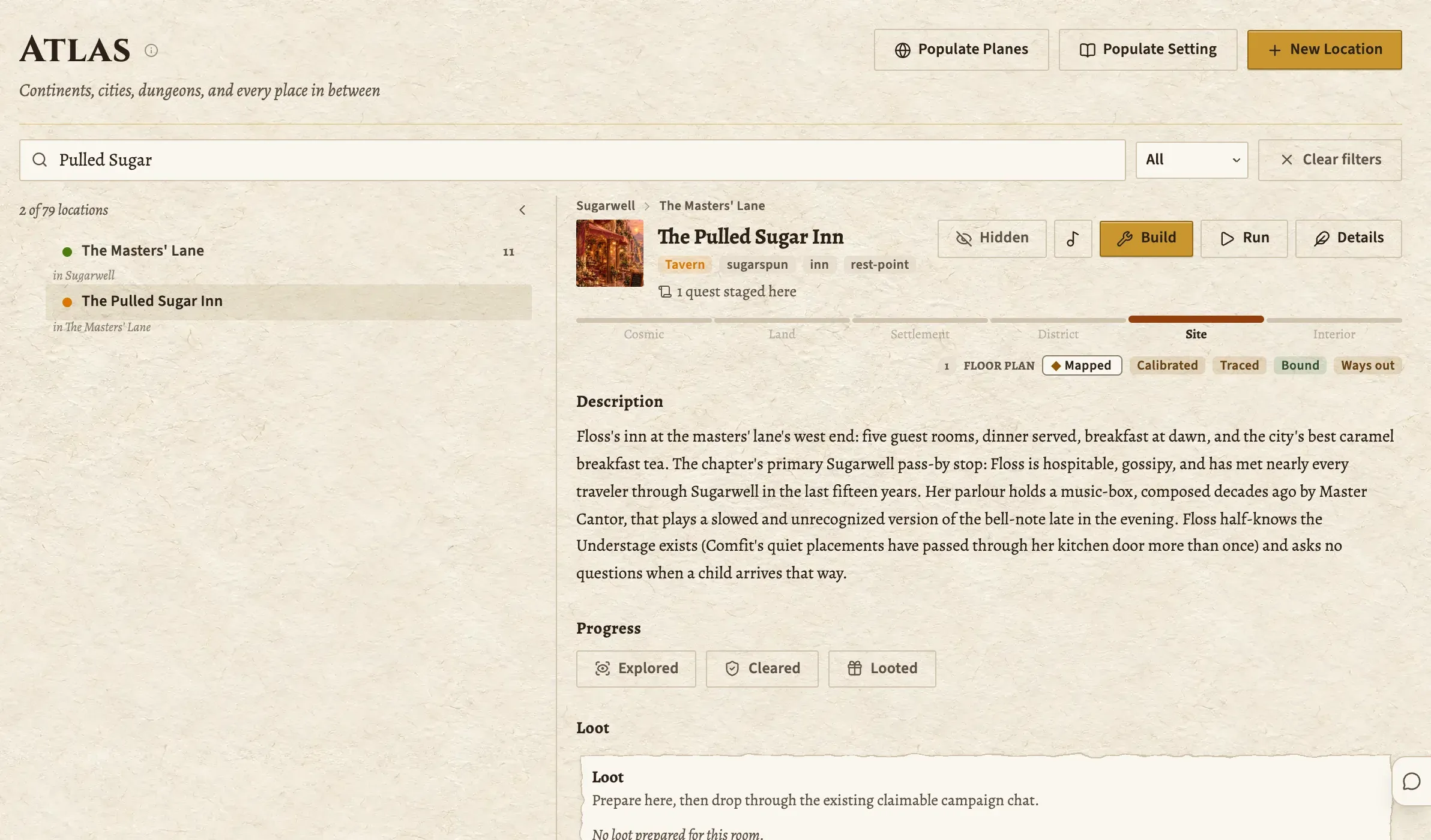
Every place in your world, nested the way your world actually nests: continent, kingdom, city, district, building, room. Click down until you hit the tavern stool. Then write a note on the stool.
THE WIKI PROBLEM
Worldbuilding tools ask you to be a librarian first and a DM second.
Open most worldbuilding software and it wants a taxonomy. Climate. Population. Primary export. Governing body. Forty-five minutes later you have a beautifully catalogued town that nobody has visited, and you have not written a single thing you'll say out loud on Friday.
Meanwhile the actual problem at the table is much smaller and much more urgent: the party has just walked into a building you invented eight months ago, and you need to remember who owns it in the next four seconds.
Atlas is organised around that second problem. Places nest inside places, you can get to any of them fast, and the fields you don't fill in aren't nagging at you. All the worldbuilding heft of the big wikis, minus the 45 minutes of filling in fields you'll never read again.
How it's built
- Real nesting
- A location contains locations. Continent → kingdom → city → district → building → room, as deep as you need.
- Setting presets
- Start from a published setting's places instead of an empty continent and a blinking cursor.
- Maps attached
- A location can carry its own map image, so the city has a city map and the dungeon has a floor plan.
- Tied to everything
- NPCs live somewhere. Quests happen somewhere. Factions hold somewhere. The links go both ways.
- Player-visible half
- The party sees the places they've been in their own Atlas tab, and nothing else.
- Notes all the way down
- You and your players can pin notes to any location. Yes, including the stool.
WHY NESTING BEATS TAGGING
A flat list with tags is a filing cabinet. A world is a tree.
Plenty of tools store locations as a flat list and let you tag them. It works right up until the party asks a question that only makes sense hierarchically. What else is in this district, who else lives in this manor, what's the next room? Then you're filtering a list instead of walking a map.
Nesting also means you can be lazy in exactly the right way. The tavern inherits its city, which inherits its kingdom. You don't restate where things are. You write the name of the innkeeper and move on, and the structure holds the rest.
IT'S NOT AN ISLAND
Every place is where something happened.
A location on its own is trivia. A location with the NPCs who live there, the quests that start there and the faction that runs it is prep. Atlas is wired into the rest of the campaign so that opening a city gets you the cast list, not just the population figure.
And your players see their half of it. Every place they've been, in their own portal, with their own notes attached, including the ones that say things like "do not go back to the warehouse."
Questions a DM would actually ask
How deep can the hierarchy go?
As deep as you're willing to type. The point of a real tree rather than a flat list with tags is that "the third room on the left of the east wing of the manor in the noble district of Waterdeep" is a place you can actually click down to, and hang a note on.
Do I have to fill it all in?
No, and please don't. This is the failure mode of the big worldbuilding wikis: 200 fields per entry, most of which you will never read again, all of which make you feel behind. Write the name. Add the rest when it matters at the table.
Can I start from an existing setting?
Yes. Nine published settings ship with location presets (Faerûn, Eberron, Greyhawk, Krynn, Barovia, Sigil, the Spelljammer sphere, Athas and Mystara), so a Forgotten Realms campaign doesn't start by you typing "Waterdeep" into an empty box.
Do my players get to see it?
They get an Atlas tab showing the places they've actually been. What's three doors deeper into the dungeon isn't in it until you say so.
Can locations have maps?
Yes, attach a map image to any location. For battle-scale maps, Cartographer paints them and the encounter runner puts tokens on them; for a regional or city map, an image on the location is usually all you want.
What's the free tier limit?
Campaign content caps apply on the free DM tier: one campaign, and caps on NPCs, monsters, encounters, documents and notes. Pro lifts them. Your players are never capped and never charged.
Your world already exists. It's just spread across four notebooks.
Start with the one city your campaign actually uses. Add the continent when someone asks about it.
Open your grimoire for freeNo card. No beta waitlist. Always free for your players.
In the same grimoire
Character Codex
Species, backgrounds, classes, archetypes and abilities. Yours, and usable by your players at character creation.
Calendars
Nine official settings' calendars built in, from Faerûn and Eberron to Krynn and Barovia. Or forge your own.
Quest Log & Factions
Every thread, who gave it and what's owed, plus guilds and cults that remember what the party did.