
D&D DOWNTIME ACTIVITIES
Interlude
The time between adventures, as something that happens rather than something you skip. Players draw downtime activities and get outcomes worth talking about at the start of the next session.
THE SMASH CUT
"Three weeks pass. You arrive at the city." And three weeks of character development evaporate.
Downtime is the most-skipped rule in the game, and it's skipped for an entirely understandable reason: running it properly means tracking days, adjudicating activities and inventing outcomes for four players who all want to do different things, none of which is happening at eleven o'clock at night.
So we say "three weeks pass" and move on, and lose the bit of the game where characters become people: where the fighter has a favourite bar, the rogue has a contact who owes them, and the wizard has been quietly buying something expensive.
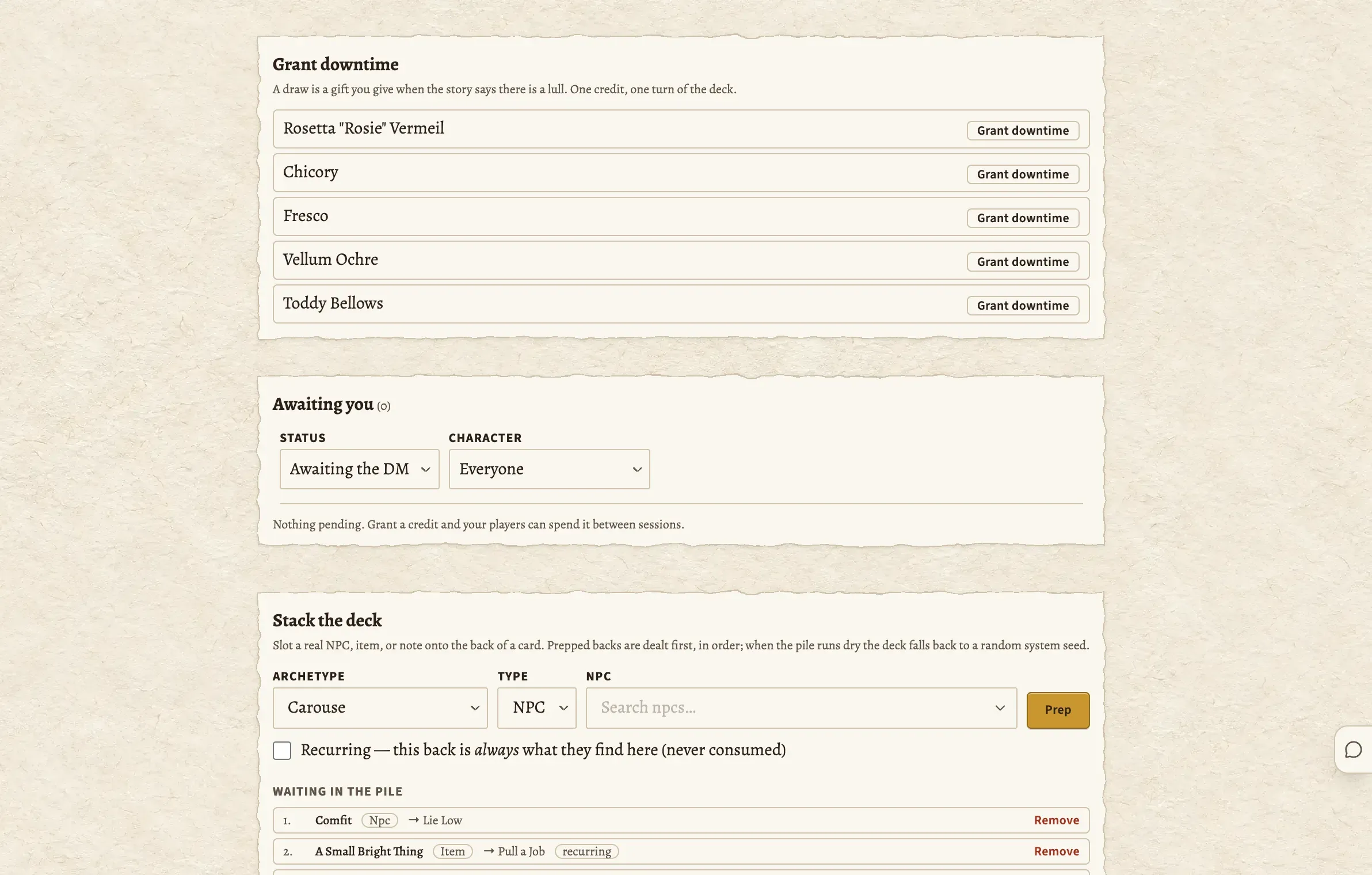
Interlude turns that into draws with outcomes. The players run it from their own portal, the days come off the calendar, and what arrives on your desk is a handful of things that happened, of which you pick the two worth a scene.
How it runs
- Draws, not forms
- Players draw downtime activities rather than filling in a request. It's a game, not paperwork.
- Real outcomes
- Each draw produces something that happened: a contact, a complication, a rumour, a small disaster.
- Counted in days
- Downtime costs time the campaign calendar actually tracks. A week means a week.
- Player-driven
- They run it from their own portal between sessions. You read the results.
- Printable as a deck
- Card Forge prints downtime seeds and outcomes, so you can deal them across the table.
- Optional rule
- Off by default. Switch it on per campaign, or never. The tab disappears entirely.
WHY A DRAW BEATS A MENU
Given a list of options, players optimise. Given an event, they react.
This is the design decision the whole module rests on. Downtime presented as a menu of activities turns into a spreadsheet exercise: every player picks the highest-value option, every time, and the interesting version never happens.
A draw produces something you didn't choose (a complication, an offer, a person, a bit of bad luck) and now there's something to respond to. It's the random-table trick applied to the space between adventures, and it works for exactly the same reason.
Questions a DM would actually ask
What is downtime for, really?
It's where characters become people. Adventuring tells you what someone does under pressure; downtime tells you what they do when nobody's shooting at them: who they drink with, what they're saving for, which grudge they're nursing. That's usually where players get attached to their own characters.
Why draws rather than a list of activities?
Because a list is a menu and a draw is an event. Given a menu, players pick the optimal option every time and downtime becomes a resource-conversion step. Given a draw, they get something they have to react to, and reacting is where the character shows up.
Does it need the calendar?
It works better with it. Downtime is measured in days, and days only mean something if the campaign is tracking dates. "You have three weeks before the coronation" is a constraint; "you have some downtime" is not.
Do I have to adjudicate every draw?
No. The draw produces an outcome; you decide which of them are worth a scene. Most sessions that's one or two (the complication that matters, the contact who becomes an NPC) and the rest is colour the players narrate themselves.
Can I turn it off?
Yes, and it's off until you switch it on. Plenty of campaigns smash-cut between adventures and that's a legitimate way to run a game. When the rule is off, Interlude disappears from your sidebar and from your players' portal entirely.
How does it relate to crafting?
They're siblings: both optional rules, both measured in downtime days, both driven from the player's portal. Crafting is downtime with a specified output; Interlude is downtime where the output is a story.
Stop smash-cutting past the best character moments in the game.
Switch the rule on for one gap between adventures and see what your players come back with.
Open your grimoire for freeNo card. No beta waitlist. Always free for your players.
In the same grimoire
Party
Heroes, companions, death saves, conditions and XP: the DM's view of everyone at the table.
Notes
Session notes and lore that link to everything else, plus a chronicler that can write the recap for you.Session notes and lore that link to everything else, so last session is always one click away.
The Mint
Mint VTT tokens from your portraits, and print setting-appropriate coins your players can stack.