
D&D PARTY TRACKER
Party
Your side of the party sheet: passive scores you need without asking, conditions in play, death saves when it goes badly, XP when it goes well, and every companion, familiar and pet in the campaign.
THE QUESTION THAT GIVES IT AWAY
"What's everyone's passive perception?" Well, now they know something's there.
Passive perception exists so that you can decide whether the party notices something without asking them to roll, because asking them to roll tells them there's something to notice. It's an elegant rule that is defeated entirely by the DM having to say the words "what's your passive perception" out loud.
The same shape of problem runs through the whole DM-side view of a party. You need the numbers, you need them without a conversation, and they live on five sheets belonging to five other people.
The party tracker is your copy: passives, proficiencies, conditions in play, death saves when it comes to that, and every companion nobody else is keeping an eye on.
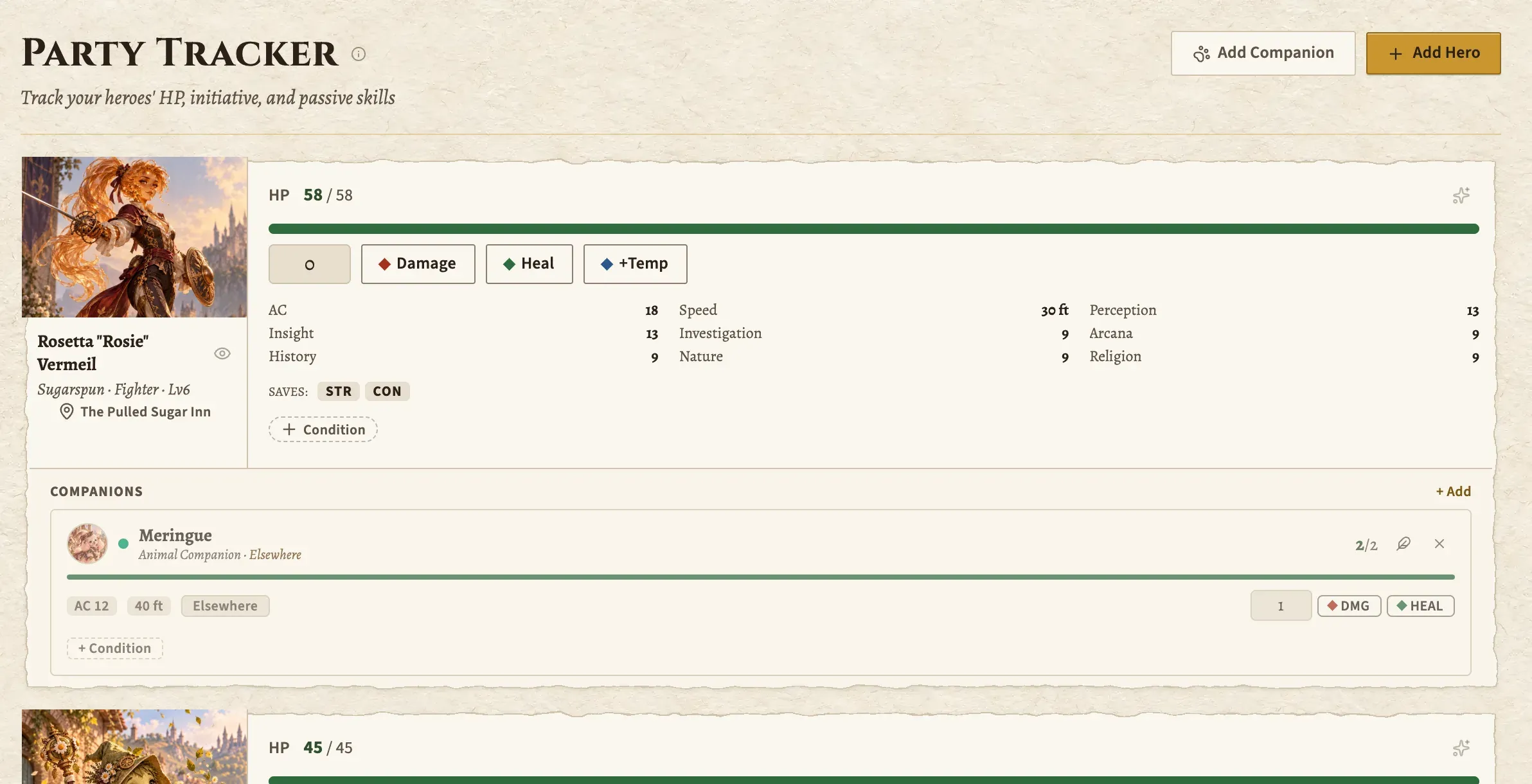
Your side of the sheet
- Passive scores
- Perception, insight, investigation: visible without asking, which is the entire point of passive.
- Conditions
- What's currently on whom, outside combat as well as in it. Curses last longer than encounters.
- Death saves
- Tracked where you can see them, on the night it matters, without a scrap of paper.
- XP awards
- Hand out experience to the party without four people doing arithmetic.
- Companions
- Familiars, mounts, animal companions and the pet nobody else is tracking.
- Proficiencies & abilities
- What each character is actually good at, when you need to set a DC that respects it.
THE CONDITION THAT OUTLIVES THE FIGHT
Combat conditions end. Curses don't.
The encounter runner handles conditions during a fight, and then the fight ends and the tracker closes. Which is right for Frightened and wrong for the curse the hag laid on the paladin in session nine.
Long-lived conditions live on the party instead: diseases, curses, exhaustion, boons, the lingering consequence you fully intended to bring back and would otherwise have quietly forgotten by session twelve.
Questions a DM would actually ask
Isn't this what the players' character sheets are for?
Their sheet is their view. This is yours, and it's a different job: you need the whole party's passive perception at a glance to decide whether they spot the ambush, and asking them is both slow and a tell.
Why does passive perception matter so much?
Because it's the number DMs need most often and the one that's least available. "What's everyone's passive perception?" asked out loud tells the table there's something to perceive, which defeats the purpose of it being passive.
What about conditions outside combat?
That's exactly the gap. The encounter runner tracks conditions during a fight. The party tracker holds the ones that outlive it: a curse, a disease, a long-term exhaustion, the thing the hag did in session nine.
Do companions get proper tracking?
Yes. Familiars, mounts and animal companions are first-class rather than a note on someone's sheet. In practice they're the things most likely to be forgotten entirely until the round someone needs them.
How does this relate to the Player Portal?
Same characters, two views. Players manage their own sheet, inventory and spells in their portal; you get the aggregate (passives, conditions, death saves, XP) on your side. Neither is a copy of the other.
Can I award XP to everyone at once?
Yes. Party-wide XP awards exist precisely so that levelling doesn't become five people doing the same addition and one of them getting it wrong.
Stop asking for the number that's meant to be passive.
One screen with the party's passives and conditions on it, on your side of the table.
Open your grimoire for freeNo card. No beta waitlist. Always free for your players.
In the same grimoire
Notes
Session notes and lore that link to everything else, plus a chronicler that can write the recap for you.Session notes and lore that link to everything else, so last session is always one click away.
The Mint
Mint VTT tokens from your portraits, and print setting-appropriate coins your players can stack.
Illuminator
A small image editor: torn edges, a vignette, colour grading and a paper texture, so a picture is finished before it goes into a handout.