
CUSTOM SPECIES, CLASSES & BACKGROUNDS
Character Codex
Write a species. Write a background. Write a class and three archetypes for it. Your players then pick them during character creation like they were always in the book.
WHERE HOMEBREW GOES TO DIE
You wrote a species. It's in a Discord message from March.
The lifecycle of most homebrew is well documented: you have a good idea, you write it up in whatever's open, you paste it into the group chat, one player says "ooh nice", and then at session zero six months later nobody can find it and everyone plays a human fighter.
It's not that the idea was bad. It's that there was no path from "written down" to "pickable during character creation", and that gap is where homebrew quietly dies, somewhere between a Discord scroll-back and a PDF nobody has open.
The Character Codex closes it. Write the species, the background, the class, the archetype. Your players find it in the character creation wizard, in the list, as if it had always been there.
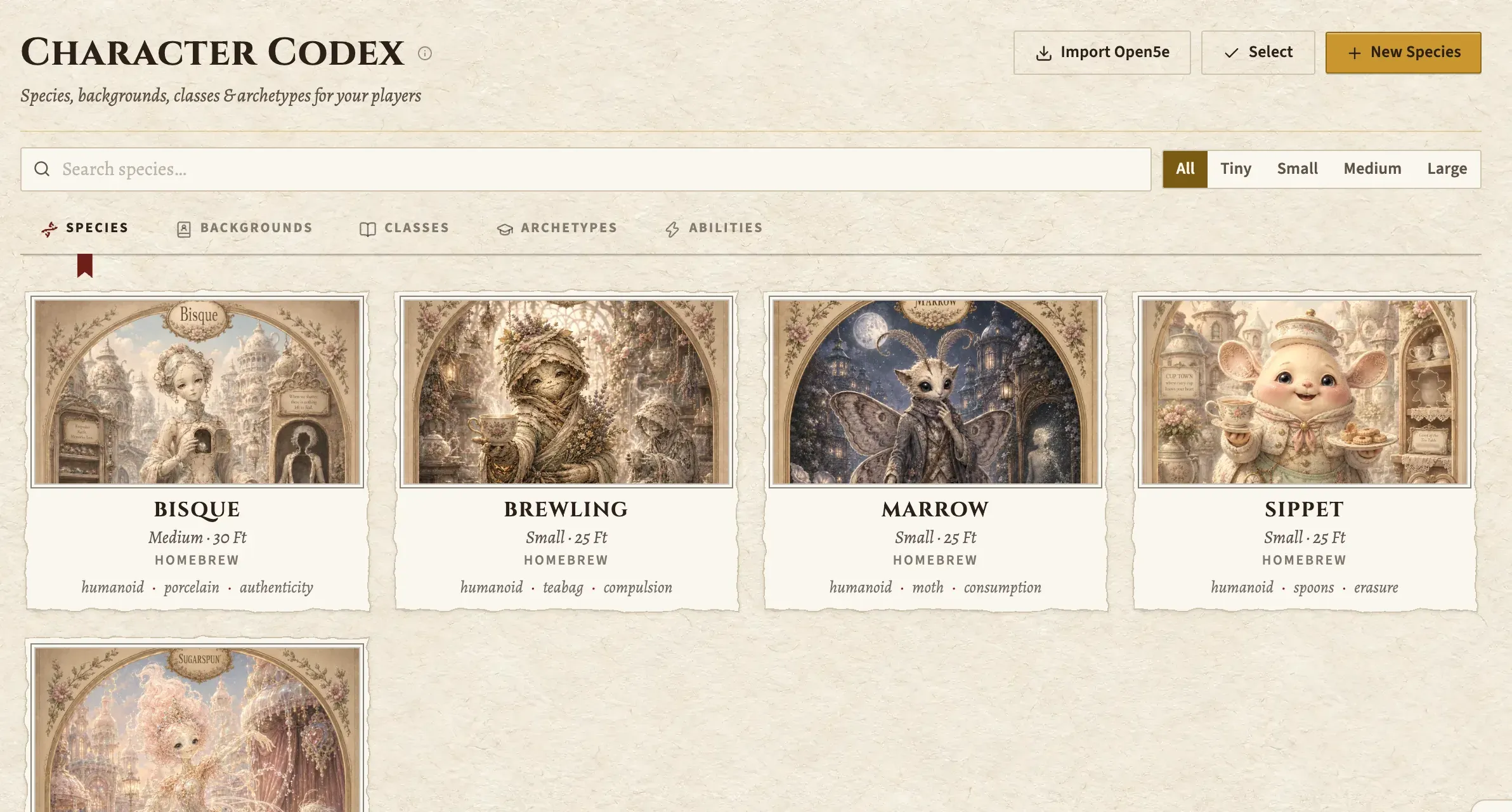
Five layers and the thing that makes them count
- Species
- Traits, ability details and the flavour that makes someone pick it. Yours, sitting next to the standard ones.
- Backgrounds
- Proficiencies, equipment and the feature that gives a character somewhere to be from.
- Classes
- Full custom classes with their own progression, not a reskin with a new name on top.
- Archetypes
- Subclasses for your classes, or for the standard ones. The layer most homebrew actually lives in.
- Abilities
- The individual features classes and archetypes hand out, defined once and reused.
- Straight into creation
- Your custom options appear in the player's character creation wizard alongside the official ones.
THE ARCHETYPE LAYER
Most good homebrew is a subclass, and most tools make that the hard case.
Ask a DM what they've actually written and it's overwhelmingly subclasses: a Circle, an Oath, a Patron, a College with a joke in the name that turned out to be genuinely good. It's the right size of idea: big enough to change how someone plays, small enough to finish.
So archetypes are a first-class thing here, not a footnote inside class definitions. Build one for a class you wrote, or for a standard one, and it appears at the level the class picks its subclass, in the wizard, where the player is already looking.
AN HONEST LIMIT
It won't tell you whether it's balanced.
There's a version of this tool that scores your homebrew out of ten and warns you that the capstone is too strong. We haven't built it, because it would be guessing. Whether a feature is overtuned depends on your party composition, your campaign's level range, how often you run short rests and whether your table treats optimisation as a sport.
What the Codex gives you instead is the fast loop: write it, put it in front of your players, watch it get used, change it. That has always been how homebrew got balanced anyway.
Questions a DM would actually ask
Do my players actually get to pick these?
That's the entire point. Anything you write in the Codex shows up in the character creation wizard in the Player Portal, next to the standard options. Homebrew that a player can't select during creation isn't homebrew, it's a document.
Can I build a whole class, or just subclasses?
Both. Archetypes are where most homebrew lives: a new subclass for an existing class is a weekend's work and slots in cleanly. But full classes with their own progression are supported if you're going to do the whole thing properly.
Does it check my balance?
No, and it isn't going to pretend to. Balance is a judgement call about your table, your party and your campaign's power level, and a tool that graded it would be confidently wrong. What it does is make sure the thing you designed is actually usable at your table.
What about the official species and classes?
SRD content is built in, so a player who wants to be a standard fighter is one click away from being a standard fighter. The Codex adds to the list rather than replacing it.
Can I reuse this across campaigns?
Codex content isn't tied to one campaign the way session notes are. It sits in the Assets side of the app with the Bestiary, Spellbook and Item Vault, so a species you wrote once is available to the next game too.
Can I publish it to other DMs?
Not as a marketplace, no. Where you can hand things around is on paper: write it up in Scriptorium and you have a document that looks like the book it's imitating.
Go and find the species in your Discord scroll-back.
Then put it somewhere a player can actually choose it at session zero.
Open your grimoire for freeNo card. No beta waitlist. Always free for your players.
In the same grimoire
Calendars
Nine official settings' calendars built in, from Faerûn and Eberron to Krynn and Barovia. Or forge your own.
Quest Log & Factions
Every thread, who gave it and what's owed, plus guilds and cults that remember what the party did.
Workshop
Crafting and cooking with real recipes, components and downtime days, tracked by the app instead of audited by you.