
CALENDAR OF HARPTOS & FRIENDS
Calendars
The Calendar of Harptos, ready on day one. So are Eberron's, Greyhawk's, Krynn's, Barovia's, Athas's and four more. Or define your own months, your own week, your own moons.
THE MOST-SKIPPED GOOD IDEA IN THE HOBBY
Everybody agrees tracking in-game time is worth doing. Almost nobody does it.
Ask a room of DMs whether the date matters and they'll all say yes. Ask them what today's date is in their campaign and you'll get a pause, then a guess, then "…roughly autumn?"
The reason isn't laziness. It's that doing it by hand means owning the Calendar of Harptos well enough to do arithmetic in it live: remembering that there are five festival days wedged between months, that Shieldmeet shows up every four years, and that thirty days is not how long a month is in your own head.
So Grimoire ships the calendars. Nine published settings, correct, on day one, and a system underneath for building your own.
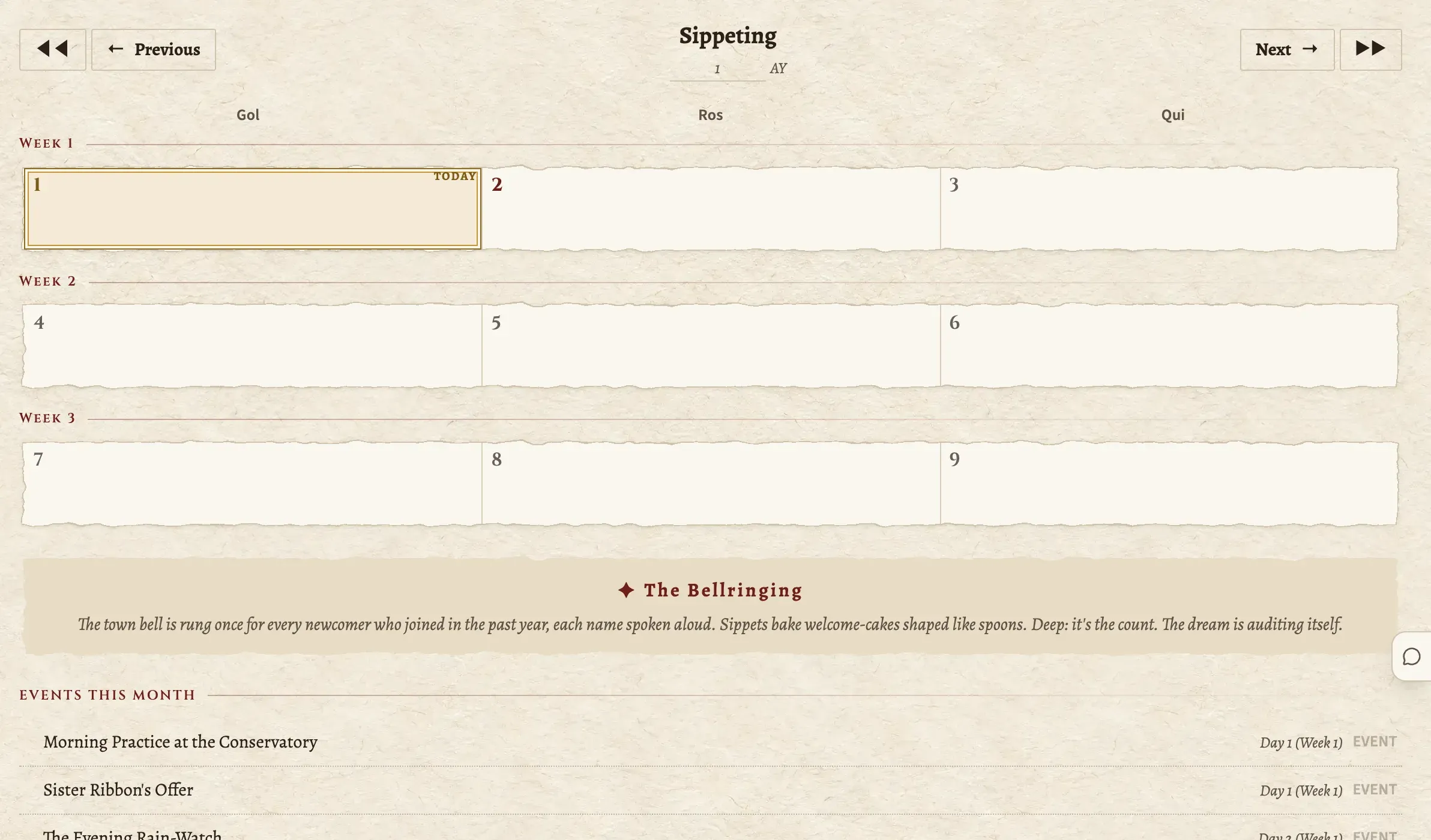
Nine settings, ready to go
Each one arrives with its calendar, its location presets and its iconic characters. The calendar is just the part you notice first.
- Faerûn
- The Calendar of Harptos: twelve months, five festival days, Shieldmeet every fourth year. Forgotten Realms as written.
- Eberron
- The Galifar calendar, with the months the Five Nations actually run on.
- Greyhawk
- The Flanaess reckoning, festivals and all.
- Krynn
- Dragonlance's reckoning, for a world that keeps ending.
- Barovia
- Ravenloft's calendar, in which the sun is a rumour.
- Sigil & the Planes
- Planescape, where "what day is it" is a philosophical position.
- Wildspace
- Spelljammer's reckoning, for campaigns that left the planet.
- Athas
- Dark Sun's reckoning, moons and all, for a world with a very short growing season.
- Mystara
- The Thyatian calendar, for the setting that raised a generation of DMs.
OR BUILD YOUR OWN
Your world doesn't have twelve months? Fine. It doesn't have to.
Homebrew settings are the reason this is a calendar system and not nine hard-coded lists. Define your months and how long they run, name the days of your week, place your festivals, and the whole app starts speaking your world's reckoning back to you.
Eight months of forty days and a week with five days in it, three of which are holy? Go on then. The date on your players' portal will say so.
WHY IT EARNS ITS PLACE
A clock is the cheapest tension you can buy.
"The ritual completes on Midwinter" is a fine line. "The ritual completes on Midwinter, which is eleven days away, and the pass takes nine to cross" is a session. The difference is entirely that the second one is checkable, by them, without asking you.
It's also what makes downtime and crafting mean anything: a project that takes a week is only interesting if everyone knows what a week costs.
Questions a DM would actually ask
Is the Calendar of Harptos actually built in?
Yes. Twelve months of thirty days, the five festival days between them, and Shieldmeet in leap years. You don't build it, look it up, or count on your fingers. Start a Forgotten Realms campaign and it's the calendar you get.
Can I make a calendar for my own setting?
Yes. Define your own months, their lengths, the days of your week and your festivals. Homebrew worlds are the reason the calendar system is a system rather than nine hard-coded lists.
Do my players see the date?
They get a Calendar tab in the Player Portal showing the in-game date in your setting's own reckoning. "How long until the festival" becomes something they can answer without asking you.
Does anything else use the date?
Yes, and that's why it's worth tracking properly. Downtime and crafting are measured in days, so the calendar is what makes "this takes a week" mean something specific rather than something vague. Notes and events can be pinned to dates too.
Why does any of this matter?
Because time pressure is the cheapest tension in the game and it only works if everyone believes the clock. "The ritual is on Midwinter" lands very differently when the party can see that Midwinter is eleven days away and the journey takes nine.
What if I've been running for a year already?
Set the current date to wherever your campaign actually is and carry on. You're not importing a history you never wrote down; you're starting the clock from today.
Find out what today's date is in your campaign.
Pick your setting, set the date, and never do festival-day arithmetic in your head again.
Open your grimoire for freeNo card. No beta waitlist. Always free for your players.
In the same grimoire
Quest Log & Factions
Every thread, who gave it and what's owed, plus guilds and cults that remember what the party did.
Workshop
Crafting and cooking with real recipes, components and downtime days, tracked by the app instead of audited by you.
Economy & Inventory
Real coins, self-sorting purses, carry weight, and a merchant who might be lying about the wand.