
PRINTABLE D&D CHARACTER SHEET
Character Sheet
Take a character that already exists in your campaign and print it: filled in, illustrated, and laid out for actual paper. The bridge between running digitally and playing on a table.
DIGITAL DM, PAPER PLAYERS
The most common table setup is the one nobody builds for.
Here's what a lot of tables actually look like: the DM has a laptop, and everyone else has paper, dice and a pencil. It works. Players like holding their character. Nobody's phone dies mid-combat. The screen stays on your side of the table, where the secrets are.
Most software treats that as a transitional state to be fixed, as though the goal were getting everyone onto the platform. It isn't. It's a preference, it's widespread, and it deserves to be supported rather than migrated.
So: take a character who exists in your campaign and print them. Filled in, illustrated, on paper, at a size a human can read across a table.
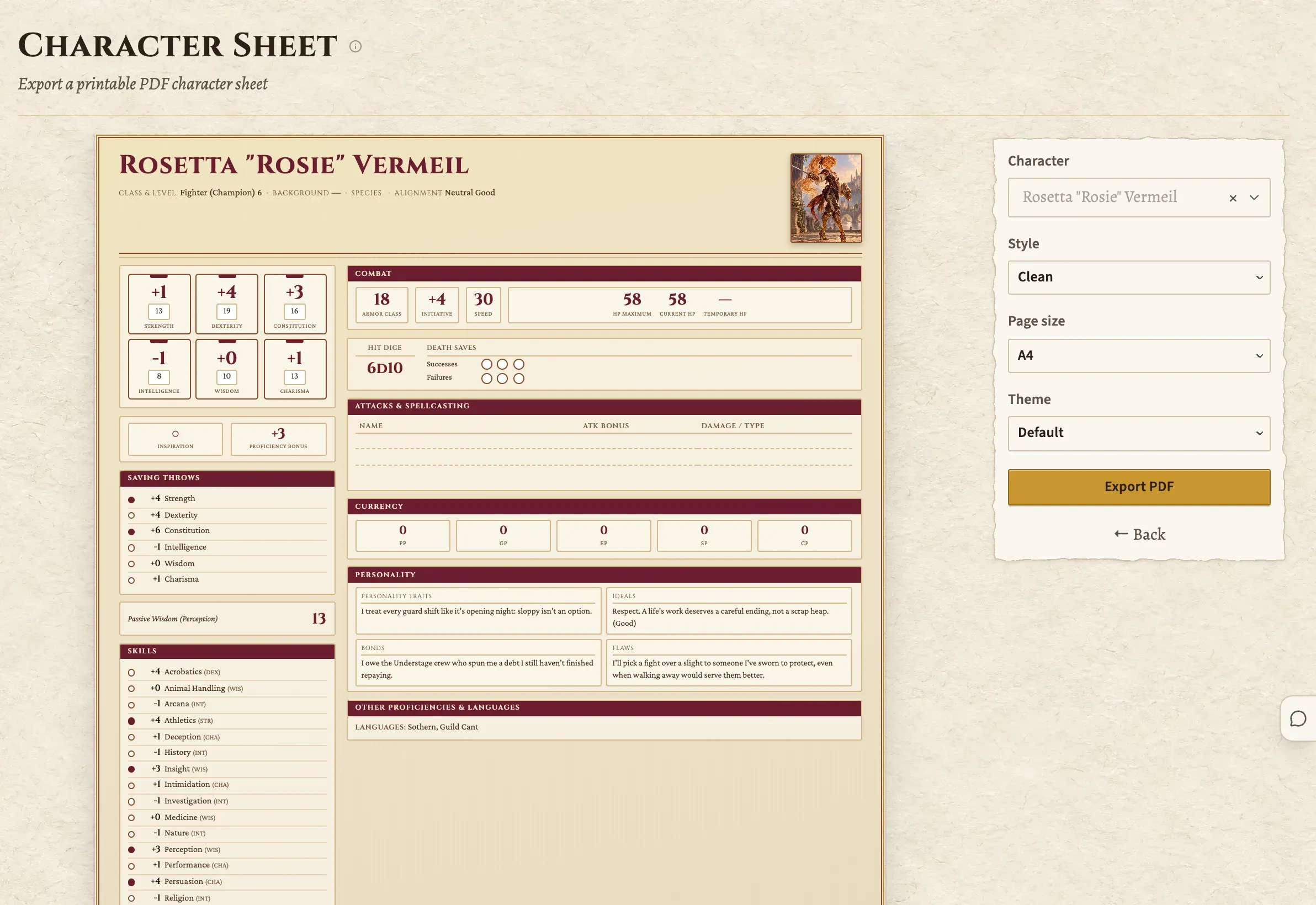
What comes out of the printer
- Already filled in
- It's a character that exists in your campaign, so the numbers are the numbers. No transcribing.
- Illustrated
- The character's portrait on their own sheet, which is a surprisingly large morale boost.
- Print-ready
- Laid out for real paper at a real size, not a screenshot of a web page.
- Any party member
- Pick whoever needs one. Useful for a guest player, a convention game or a backup character.
- Homebrew included
- Custom species, backgrounds and classes from the Codex print like the standard ones.
- For the paper table
- Run your prep digitally and still hand everyone a sheet. The two aren't opposites.
THE TRANSCRIPTION TAX
Every blank sheet PDF costs someone forty minutes.
The standard route is a blank official PDF and a player copying numbers into it (ability scores, modifiers, saves, proficiencies, spell DCs) and getting one of them wrong in a way nobody notices until session six, when a save that should have succeeded doesn't.
Generating the sheet from a character that already exists removes both the forty minutes and the error. It also means a level-up is a reprint rather than an eraser and a fresh copy.
Questions a DM would actually ask
Why would I want paper if the app has a character sheet?
Because plenty of tables prefer it, and "digital DM, paper players" is an extremely common and entirely reasonable setup. The point of Grimoire is to take the bookkeeping off you, not to insist everyone at the table looks at a screen.
Is it filled in, or a blank template?
Filled in. It reads a character that already exists in your campaign, so the ability scores, proficiencies, equipment and spells are the ones that character actually has. The whole value is not typing them again.
Does it handle my homebrew?
Yes. A character built with a custom species, background or class from the Character Codex prints with those, the same as a standard one. Homebrew that can't be printed is homebrew that stays theoretical.
What about a character who levels up?
Reprint it. The sheet is generated from current state rather than saved as a static file, so the version you print after a level-up is the version that's true.
Can players print their own?
The export lives on the DM side, in the Publish group. In practice this means you run one print job before a session rather than four players each fighting a printer, which is usually the better outcome anyway.
Does it work for NPCs and companions?
It's built around party members, the characters with full sheets. For NPCs and monsters, the Card Forge card or the Bestiary reveal sheet is usually what you actually want in your hand.
Print the party's sheets before Friday.
Same characters, on paper, correct. Then keep the laptop for the bit that actually needs one.
Open your grimoire for freeNo card. No beta waitlist. Always free for your players.
In the same grimoire
Reliquary
A DM screen, the rules you keep looking up, your house rules, and trackers for the things you always forget.
Dungeon Craft
Secret doors, traps, hazards and puzzles, with hints, skill checks and something to actually hand the players.
Loot & Roll Tables
Roll tables for anything, and loot tables that drop real items into real inventories.