
D&D LOOT TABLES & RANDOM TABLES
Loot & Roll Tables
Random tables for whatever you improvise from (rumours, weather, what's in the pocket), and loot tables whose results are actual items that land in an actual bag.
THE OLDEST TOOL IN THE HOBBY
The random table has survived fifty years of design because it does something nothing else does.
A good random table isn't a substitute for imagination. It's a way of surprising yourself, of getting a result you wouldn't have chosen and then having to justify it, which is where a startling amount of the best improvisation at a table comes from.
They've been in the game since the beginning and they're still in it, because that trick has never been improved on. The only thing that has ever gone wrong with random tables is the admin: keeping them somewhere findable, weighting them properly, and, for loot, writing down what everyone just got.
So: tables you can roll live, weighted the way a table should be, and loot results that are actual items landing in actual bags.
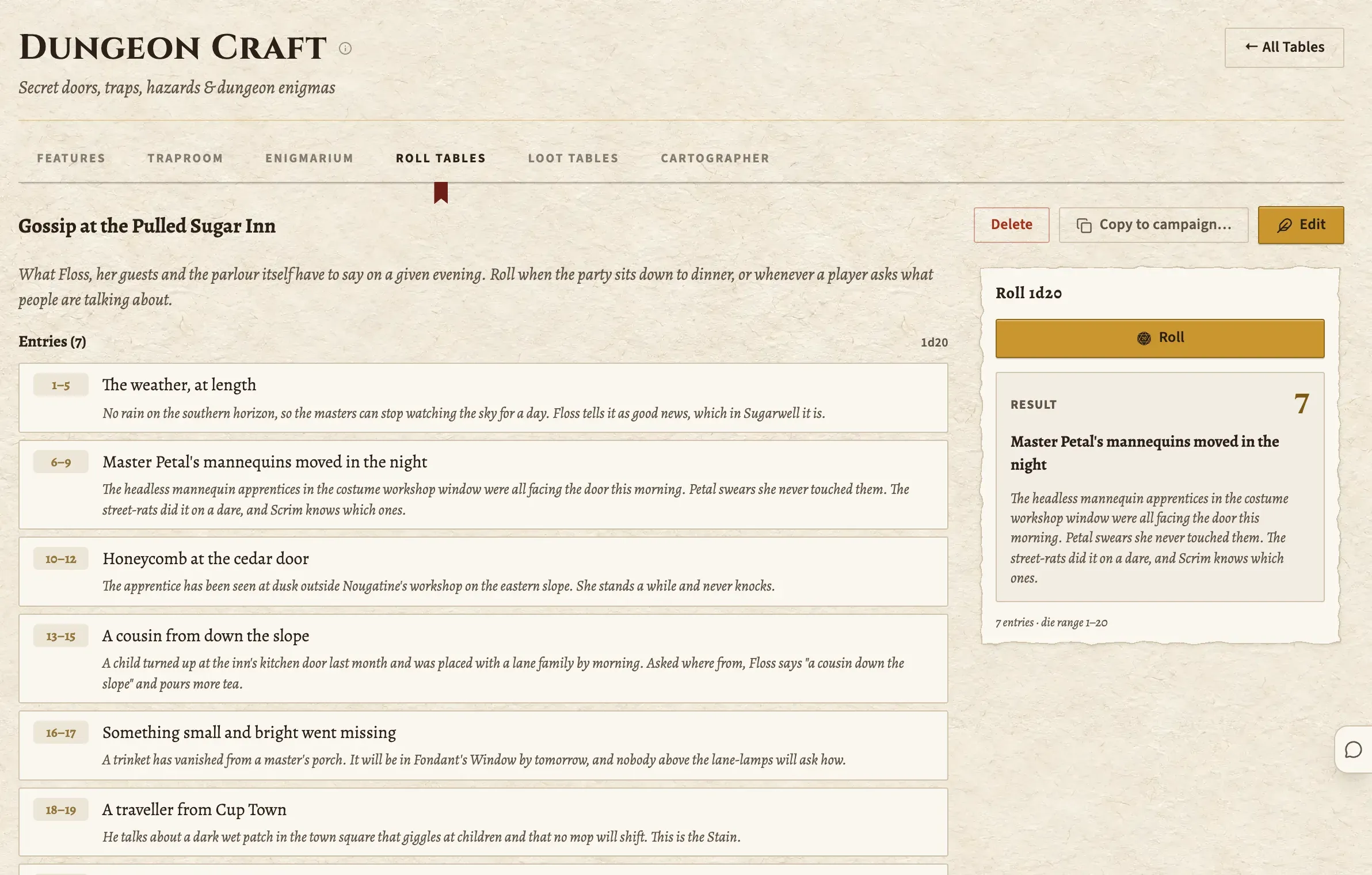
What they do
- Roll tables for anything
- Rumours, weather, what's in the pocket, what the guard is doing. The DM's oldest and best tool.
- Loot tables that drop
- Results are real items, not text. They land in an inventory rather than in your reading voice.
- Weighted entries
- Common things common, rare things rare. A table where everything is equally likely isn't a table.
- Roll at the table
- Hit it live when the party does the thing you didn't prepare for. That's what it's for.
- Reusable across campaigns
- A good rumour table outlives the campaign you wrote it for.
- Printable as cards
- Loot can go to Card Forge and come out as a stack the party divides by hand.
THE LOOT DIFFERENCE
A loot table that gives you text has done half the job.
Roll on a printed treasure table and you get a line: "a silvered dagger, 40gp, and a potion of healing". Now you read it out, and five people write it down, and one of them writes it down wrong, and in three sessions there's a dispute about who has the dagger.
A loot table here drops items, the same objects that live in your Item Vault with weight and value attached, straight into inventories. The dispute doesn't happen because the dagger is demonstrably in someone's bag.
And if you'd rather make a moment of it, send the haul to Card Forge in loot mode and hand the party a stack of cards to divide.
Questions a DM would actually ask
What makes a loot table different from a roll table?
A roll table gives you a result to read out. A loot table gives you an item: a real one, from your Item Vault, which drops into a character's inventory with its weight and value attached. One saves you improvising; the other saves you improvising and transcribing.
Can I weight the entries?
Yes, and you should. The whole craft of a random table is that the boring result is common and the interesting one is rare. An even distribution turns every roll into a coin flip and every table into a list.
Are these just for dungeons?
No. They live under Dungeon Craft because that's where they were born, but a rumour table for a city, a weather table for a sea voyage or a complications table for downtime are all the same shape and all more useful outside a dungeon than in one.
Can I generate a table?
There's a generator for roll tables if you want twenty entries to edit rather than twenty blank rows. With AI off it disappears and you write your own, which is frankly the more satisfying route anyway.
Do players see the tables?
No. The table is the machinery behind a result. The party just gets the result. What they see is the rumour, the weather or the item in their bag.
Why not just use a table from a book?
Use both. The ones in books are good and you should steal them. What you can't do with a printed table is have its loot results land straight in a character's inventory, or reroll it four times in a session without losing your place.
Build one rumour table. Use it for the next three years.
Twenty weighted entries is an evening's work and the best improvisation insurance there is.
Open your grimoire for freeNo card. No beta waitlist. Always free for your players.
In the same grimoire
Hall of Heroes
Iconic characters, ready to import into any campaign. For one-shots, new players and sudden deaths.
Pantheon
Gods, domains and divine lore that hangs together, and the churches that fight about it.
Interlude
Downtime draws and the outcomes they spit out, so something actually happens in the week between adventures.