
D&D TRAPS, PUZZLES & DUNGEON FEATURES
Dungeon Craft
The furniture a dungeon is made of. Traps with their detection and disarm DCs, puzzles with layered hints and the skill checks that crack them, secret doors, and hazards worth stepping around.
THE TWENTY-MINUTE SILENCE
The puzzle was great. The part where they got stuck was not.
Everyone has run this. You write a genuinely clever puzzle. The party engages with it. And then they go down a wrong path and stay there for twenty minutes, and you have to improvise a hint that nudges without gifting, live, under pressure, with five people looking at you.
The improvised hint is almost always too much or too little. Too little and the silence continues; too much and you've solved your own puzzle for them, which satisfies nobody.
Writing hints in layers ahead of time (a nudge, then a stronger one, then the shape of the answer) takes four minutes when you're calm and completely changes how that scene goes. Dungeon Craft is mostly a structure that makes you do the four minutes.
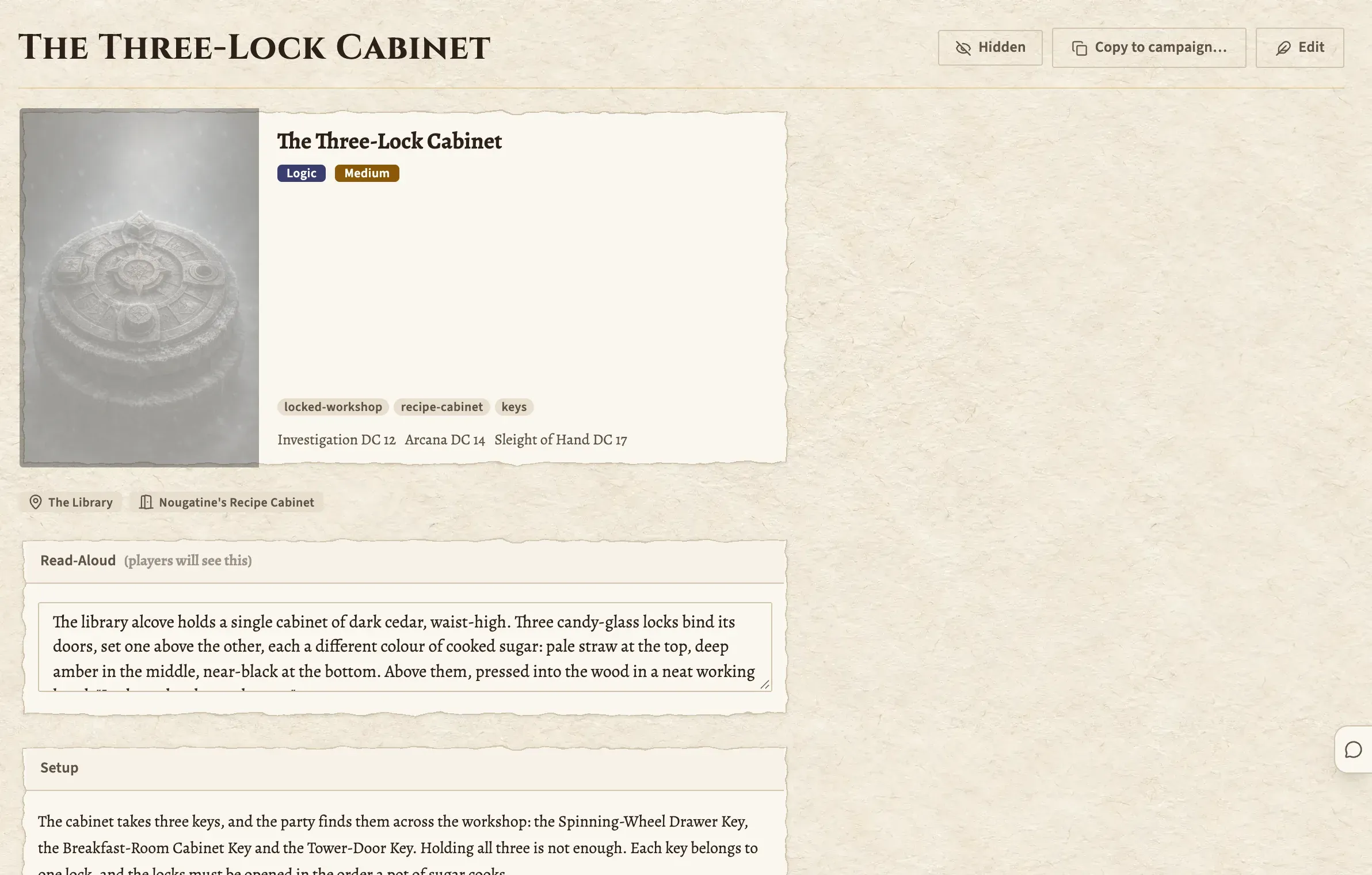
The furniture a dungeon is made of
- Traps
- Detection DC, disarm DC, trigger, effect. The four things you need and always have to invent twice.
- Puzzles
- The puzzle, its solution, and layered hints for when the table has been stuck for twenty minutes.
- Skill checks
- Which checks crack it and at what DC, decided in advance rather than improvised under pressure.
- Something to hand over
- Puzzles have a share panel, so the players get the puzzle rather than your description of it.
- Dungeon features
- Secret doors, hazards, and the furniture that turns a corridor into a place.
- Reusable
- Built once, dropped into any dungeon. Good traps deserve a second outing in a different campaign.
TRAPS, SPECIFICALLY
A trap is four numbers you will otherwise invent twice.
Detection DC, disarm DC, trigger, effect. That's a trap. And if they aren't written down you'll decide the detection DC when someone searches, forget it, and decide a different one when the next character searches from the other side of the corridor.
Players notice that. Consistency behind the screen is most of what makes a dungeon feel like a real place with real rules instead of a series of rulings. Four fields, decided once.
Questions a DM would actually ask
Why do puzzles need software?
Because the hard part isn't inventing the puzzle. It's the twenty minutes where the party is stuck and you have to improvise a hint that helps without solving it. Writing hints in layers, in advance, when you're calm, is the whole trick. The tool just makes you do it.
What's the share panel?
A way to put the puzzle in front of the players directly rather than describing it. Riddles, ciphers and visual puzzles land very differently when the table can look at the thing instead of listening to you paraphrase it twice.
Do traps work in encounters?
Encounters can carry traps, so the pit that opens on round two is part of the fight, not an afterthought you remember to mention. Detection and disarm DCs travel with the trap.
What counts as a dungeon feature?
The things that aren't monsters and aren't loot: secret doors, hazards, environmental effects, the enigmas that make a room worth describing. Collectively they're what separates a dungeon from a series of rooms containing goblins.
Can I generate these?
There are generators for traps, puzzles and roll tables if you want a starting point to edit. With AI switched off they disappear and the editors work exactly as before. The structure is the useful part either way.
Where do loot tables live?
Same module. Dungeon Craft is the hub for traps, puzzles, features, roll tables and loot tables. Loot and roll tables have their own page since they're useful well outside a dungeon.
Write the hints before the silence, not during it.
One puzzle, three hints, four minutes. It'll change how that scene goes.
Open your grimoire for freeNo card. No beta waitlist. Always free for your players.
In the same grimoire
Loot & Roll Tables
Roll tables for anything, and loot tables that drop real items into real inventories.
Hall of Heroes
Iconic characters, ready to import into any campaign. For one-shots, new players and sudden deaths.
Pantheon
Gods, domains and divine lore that hangs together, and the churches that fight about it.