
D&D INVENTORY & COIN TRACKER
Economy & Inventory
Players can only buy what they can afford. The purse makes its own change. The item lands in their bag with the right weight. What the item actually is stays between you and your conscience.
THE ARITHMETIC TAX
Nobody's favourite session was the one with the shopping trip.
A party walks into a market with 9,000 copper pieces, 40 silver and some gems, and wants to buy three things at prices quoted in gold. What follows is eleven minutes of five people doing base conversion out loud, one of whom is definitely wrong.
The same tax shows up everywhere money and stuff do: encumbrance nobody adds up, a hoard read aloud from a list, a player who has been carrying four suits of plate armour since session nine and knows it.
None of that is the game. It's the admin around the game, and it's exactly the sort of thing that should happen invisibly while everyone is talking about something more interesting.
What runs itself
- Self-sorting purses
- Pay 60gp with 9,000 copper and the purse works out the change. Nobody does base-10-then-10 maths at the table.
- Can't-afford-it is enforced
- Players buy what they can pay for. The awkward conversation happens between them and the arithmetic.
- Carry weight
- Adds itself up as things go in the bag. The rule finally applies without you policing it.
- Paper doll
- Equipped gear in slots, so what's actually worn is visible rather than inferred from a list.
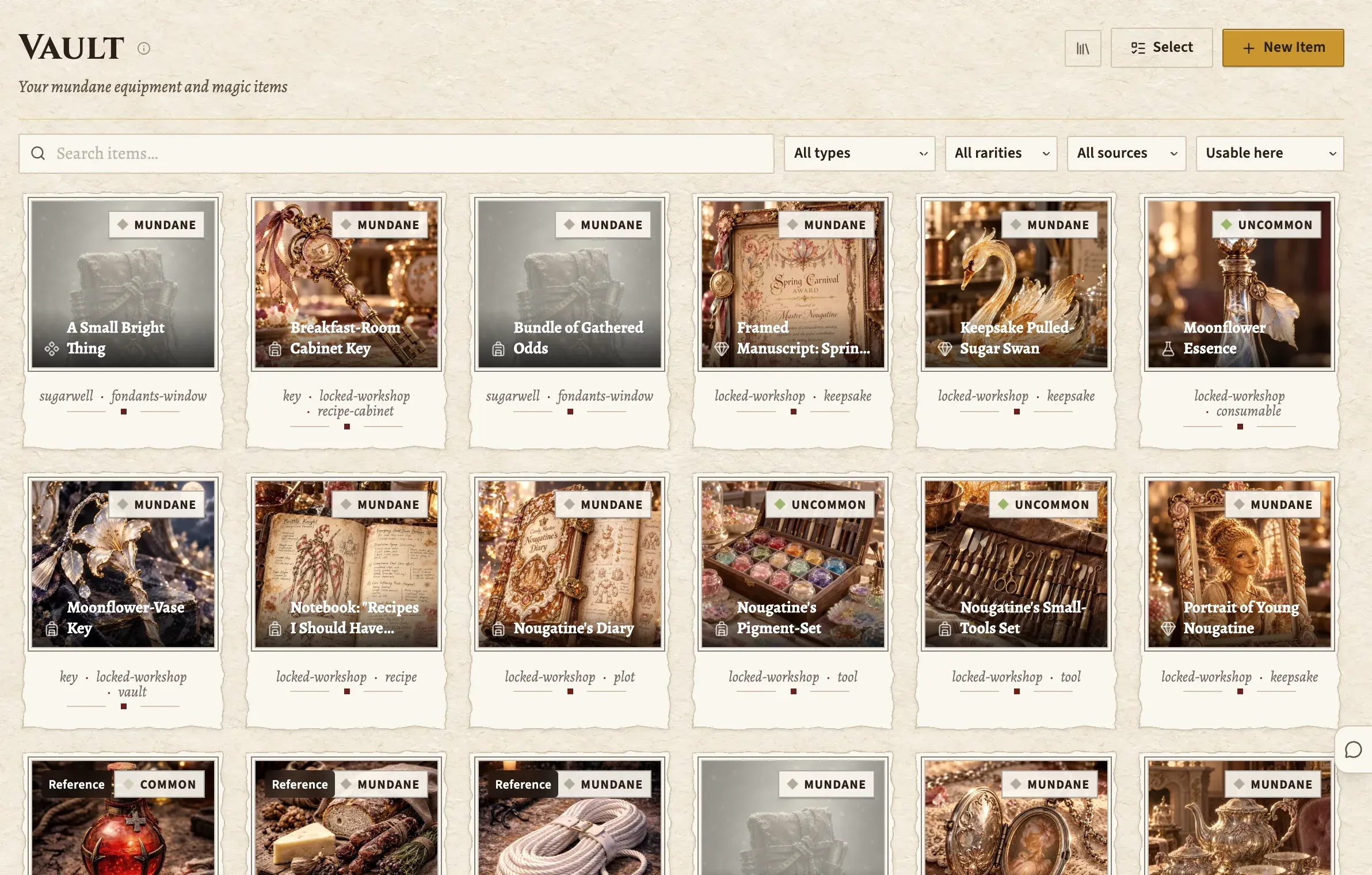
- Item Vault
- Your equipment and magic items, with the DM-side truth attached to each one.
- NPCs who sell
- Hand stock to a merchant and let them trade. The shop runs; you play the shopkeeper.
- What it really is
- An item's true nature is DM-only until you reveal it. The wand can hum as much as you like.
- Loot, dealt out
- A haul can be printed as cards in Card Forge and divided by hand instead of read aloud.
THE BEST BIT
A merchant who might be lying.
Every item has two descriptions: the one the party is given, and the one that's true. Pitch the Gnarled Wand of Whispering Arcana at sixty gold ("hums faintly, definitely magical") and let a player buy it with money they actually have.
What it is, behind your screen, is an ordinary twig. It stays an ordinary twig, marked DM-only, until the day you decide to reveal it. Grimoire handles the coins, the change and the weight of the twig. What the item actually is remains between you and your conscience.
AND WHEN THE HOARD DROPS
Deal it out instead of reading it out.
The end of a big fight is usually followed by you reading a list while five people write things down. It's the flattest possible ending to the best part of the session.
Because items live in the same grimoire as everything else, a haul can go straight to Card Forge in loot mode and come out as a stack of printed cards. Put it on the table and let them divide it. Same loot, entirely different ten minutes.
Questions a DM would actually ask
Do I have to track every copper piece?
You don't track anything. That's the point. The players hold their own purses and the app does the conversions. If your table would rather hand-wave money entirely, that still works; nothing here forces an economy on you.
How does the merchant thing work?
Give an NPC some stock and a price. Players can buy from them, the coin comes out of their purse, the item lands in their bag with the right weight. You get to play the character instead of being the till.
Can I lie about what an item is?
Enthusiastically. An item has what the party is told and what it actually is, and the second one is DM-only until you reveal it. The Gnarled Wand of Whispering Arcana can go on humming faintly for as long as you can keep a straight face.
Does carry weight actually get enforced?
It's tracked and shown, which is most of the battle. Encumbrance is a rule almost every table ignores purely because adding it up by hand isn't worth it. Whether you enforce the penalties is still your call.
What's the difference between Item Vault and inventory?
The Vault is your library of item definitions: the things that exist in your world. Inventory is what a specific character is carrying right now. You write a magic sword once; three characters can carry it across two campaigns.
Can players trade with each other?
Items move between characters, which is the part that matters when the party divides a hoard. The negotiation about who gets the sword remains, as ever, entirely your problem.
Give the party a purse that does its own maths.
Then sell them something that hums faintly and see how long it takes.
Open your grimoire for freeNo card. No beta waitlist. Always free for your players.
In the same grimoire
Portrait Gallery
Original painted-style art for every hero, NPC and villain, and one gallery holding all of it.
NPCs
The whole cast, with relationships, secrets, inventories and the note your player wrote about them.
Bestiary
Open5e's SRD monsters, a builder for your own, and a reveal sheet for showing players exactly what you want.
Spellbook
The SRD spell list plus your own homebrew, with a level advisor for when you're not sure what you've built.