
CUSTOM D&D SPELLS
Spellbook
Write custom spells with components, classes and effects, sitting alongside the SRD list. There's even a level advisor for the eternal question of whether your new spell is a 3rd-level spell or a 5th.
THE SECOND-HARDEST HOMEBREW
Writing the spell is easy. Deciding it's a 4th-level spell is not.
Everyone has written a spell. It has a great name, a vivid effect and exactly the flavour your setting needed. And then comes the part that stops most homebrew from ever reaching a table: deciding what level it is, and whether it quietly breaks the game at that level.
There's no formula. There's a feel for it that comes from having read a lot of spells and compared them, which is precisely the sort of comparison a tool can help with, without pretending it can make the call for you.
So the Spellbook has a level advisor: it looks at what you've built, tells you where it sits against spells of nearby levels, and leaves the decision with you. Then the spell goes into the same compendium as the SRD list, and onto the character sheets of everyone who can cast it.
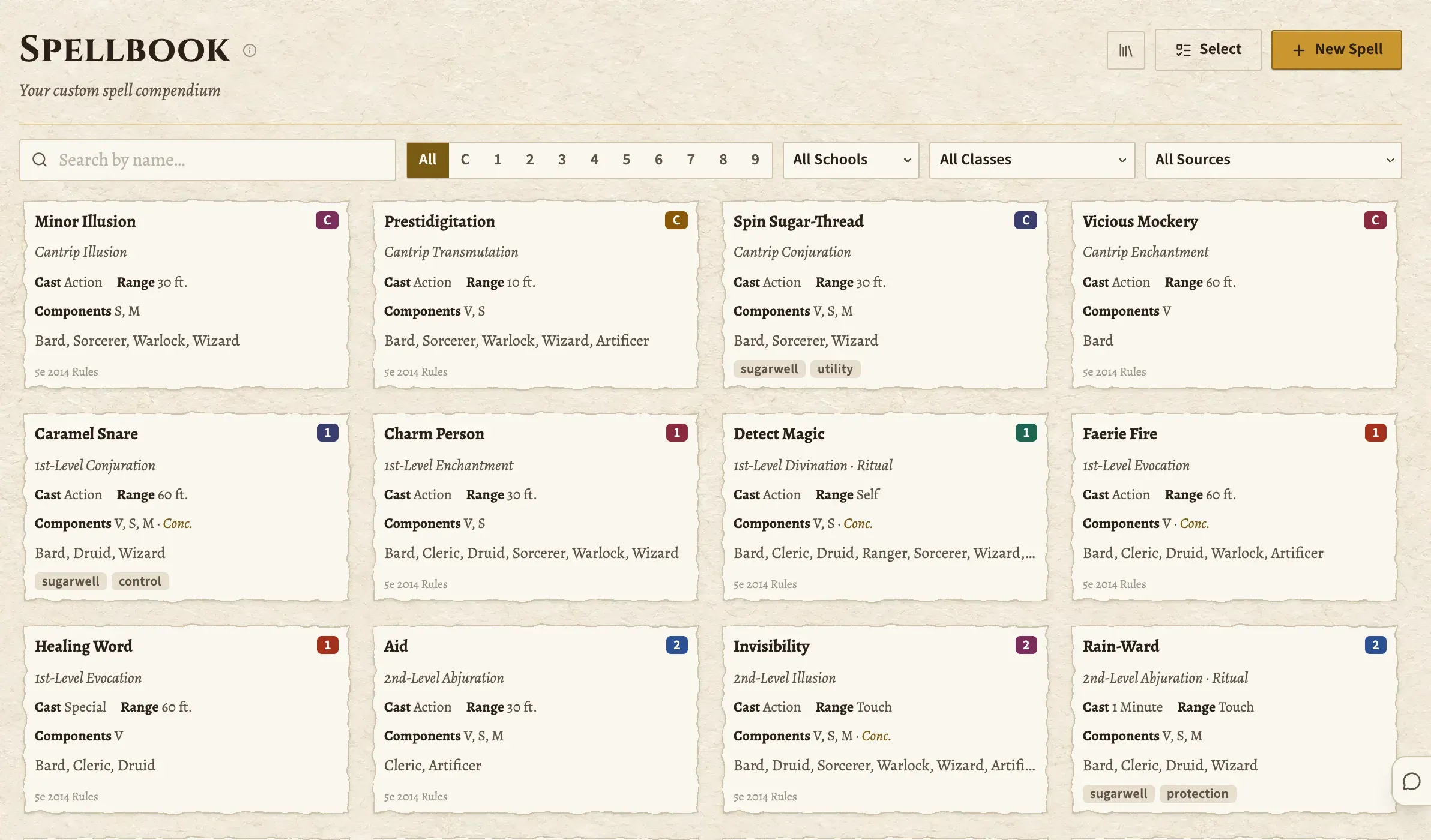
What a spell carries
- Components
- Verbal, somatic, material, including the pinch of something you invented and priced at 50gp.
- Casting classes
- Which classes get it, and at what level, so it lands on the right character sheets.
- Effects
- Effects with structure behind them, so the spell means something to the rest of the app.
- Level advisor
- The honest second opinion on whether what you've written is a 3rd-level spell or a 5th.
- SRD included
- The standard spell list is there. Yours sits alongside it, not in a separate list nobody opens.
- Innate spells
- Grant a spell to a creature or character directly: the ability that isn't from a class list.
WHY STRUCTURE BEATS PROSE
A spell written as a paragraph is a spell only you can use.
Most homebrew spells live as text. That's fine for reading and useless for everything else: it can't appear on the right character sheets, can't be filtered by class, can't be printed as a card without retyping, and can't be found by the player who half-remembers it.
Writing components, casting classes and effects as fields costs you an extra minute at the point of creation and buys you all of the above. Your bard finds the spell you wrote for bards, in their spell list, because you ticked "bard".
Questions a DM would actually ask
What's the level advisor?
A second opinion on the hardest question in spell homebrew: is this balanced for the level I put it at? It's advice, not a verdict. It compares what you've written against the shape of spells at nearby levels and tells you where it sits. You're still the one deciding.
Do custom spells reach my players?
Yes. A spell you write with the right casting classes appears on the character sheets of players who can cast it, in their own portal, in the Spellbook tab. Homebrew that a player can't actually prepare isn't finished.
What are innate spells?
Spells granted directly to a character or creature rather than through a class list: a boon, a curse, a racial ability, a thing that happened to them in session eleven. They show up as theirs without pretending to be class features.
Is the SRD spell list included?
Yes, built in and free, the same as the SRD monsters. Your homebrew sits in the same compendium rather than in a separate list your players forget to check.
Can I print a spell?
Card Forge prints spells as cards, which is a genuinely good way to run a prepared list. The caster holds their spells as a hand and turns one face-down when it's spent. Tapping out feels different when it's physical.
Does it enforce spell slots?
Slots live on the character sheet and in the encounter runner's PC panels, so what a caster has available is visible. The Spellbook itself holds the definitions. Tracking what gets spent happens where the spell is cast.
That spell you wrote for one player, three campaigns ago.
Put it somewhere they can actually prepare it, and find out what level it should have been.
Open your grimoire for freeNo card. No beta waitlist. Always free for your players.
In the same grimoire
Character Sheet
Export a filled-in, illustrated character sheet for any party member. Paper, for the table that likes paper.
Reliquary
A DM screen, the rules you keep looking up, your house rules, and trackers for the things you always forget.
Dungeon Craft
Secret doors, traps, hazards and puzzles, with hints, skill checks and something to actually hand the players.