
D&D CRAFTING & DOWNTIME
Workshop
Recipes, components, tool proficiencies and downtime days, all resolved by the app. Players forge the sword. You do not audit anyone's inventory to find out whether they could.
WHY CRAFTING ALWAYS DIES
Every table tries crafting once. Almost none of them try it twice.
The pattern is reliable. Someone wants to forge a sword. You look up the rules. There's a component list, a cost, a downtime duration and a proficiency check, and it turns out that running it properly means you auditing a player's inventory and a calendar you weren't keeping.
So you wave it through ("sure, it takes a week") and the system quietly becomes a formality. Which is a shame, because RPGs spent twenty years teaching everyone at your table to love exactly this: gathering the thing, spending the time, making the object.
The systems aren't the problem. The bookkeeping is. So Grimoire runs the bookkeeping and leaves you the rulings.
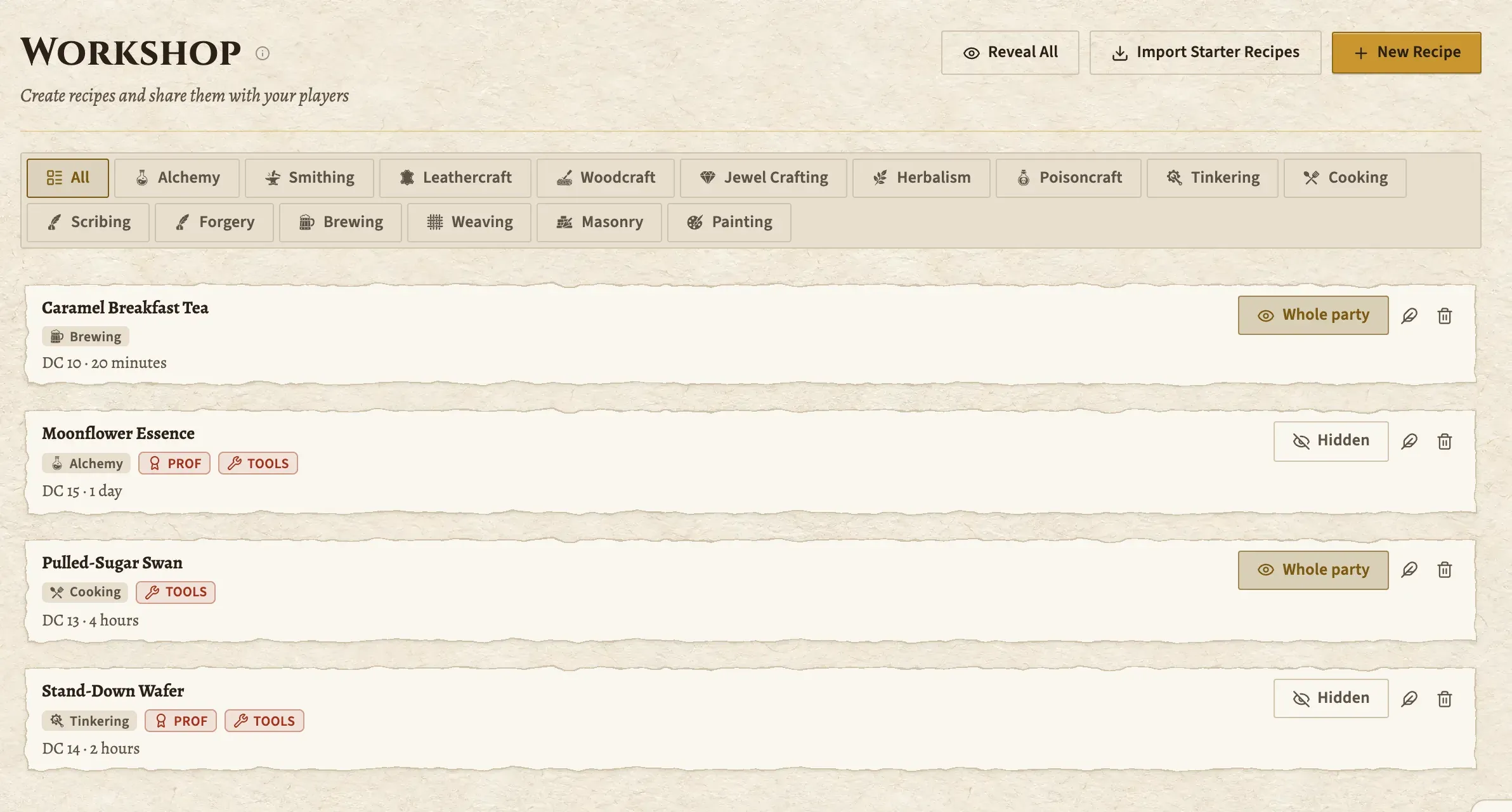
What it runs for you
- Recipes
- What it takes, what it makes, how long it runs. Written once, used by everyone at the table.
- Components
- Checked against what the player is actually carrying, not against what they claim to be carrying.
- Cooking
- Food as its own thing, because a party that cooks is a party that talks to each other at camp.
- Downtime days
- Projects measured in days that the campaign calendar actually counts.
- Player-driven
- They start the project from their own portal. You approve the interesting parts.
- Switch it off
- Crafting and downtime are optional rules. Turn them off and the tabs disappear, for you and for them.
THE DIVISION OF LABOUR
They start the project. You make the interesting call.
The reason crafting collapses onto the DM is that the DM ends up being the database: what have you got, how long has it been, can you afford it, do you have the tools. All of that is lookup, and lookup is the one thing software is unambiguously better at than a person running a game at half past nine.
So the player drives it from their own portal (their inventory, their tool proficiencies, their days) and the thing that reaches you is the decision. Is the moonsilver available in this town? Does the forge-master want something in return? That's a scene. The subtraction isn't.
AND IF YOU HATE IT
One switch, and it was never there.
Crafting and downtime are optional rules, per campaign. Plenty of tables genuinely don't want them: the game is about the dungeon, the week between sessions is a smash cut, and a crafting tab is just clutter.
Turn the rule off and the module disappears from your sidebar and from your players' portal. Not greyed out, not upsold, not sitting there with a lock icon. Gone.
Questions a DM would actually ask
Is crafting compulsory?
No. It's an optional rule you enable per campaign, and it's off until you say otherwise. Switch it off and the Workshop vanishes from your sidebar and from your players' portal, rather than sitting there as a tab nobody opens.
Whose job is the arithmetic?
Not yours. The player starts the project, the app checks the components against their actual inventory and counts the days against the campaign calendar. What lands on your desk is the decision: whether the rare component is available, what the complication is. That's the part worth your attention.
Does it use the official crafting rules?
It gives you a recipe system rather than hard-coding one edition's rules, because the official crafting rules are famously the part of the game everyone houserules. Write recipes that match whatever your table uses.
What's Interlude?
The downtime module that sits next to Workshop: downtime draws and the outcomes they produce, for the time between adventures. Also an optional rule, also player-facing, and it can be printed as a deck in Card Forge if you'd rather deal downtime than describe it.
Does cooking actually matter?
Mechanically that's your call. Narratively it's one of the best-value systems in the game: a camp scene with someone cooking is a scene where players talk to each other in character without you having to engineer it.
Can my players see their own projects?
Yes. Workshop is one of their portal tabs when the rule is on. They track their own in-progress work, which is the only reason a crafting system ever survives contact with a real campaign.
Let someone forge the sword properly this time.
Write one recipe, switch the rule on, and see whether your table takes it seriously when the numbers add up on their own.
Open your grimoire for freeNo card. No beta waitlist. Always free for your players.
In the same grimoire
Economy & Inventory
Real coins, self-sorting purses, carry weight, and a merchant who might be lying about the wand.
Portrait Gallery
Original painted-style art for every hero, NPC and villain, and one gallery holding all of it.
NPCs
The whole cast, with relationships, secrets, inventories and the note your player wrote about them.
Bestiary
Open5e's SRD monsters, a builder for your own, and a reveal sheet for showing players exactly what you want.