
D&D QUEST LOG & FACTION TRACKER
Quest Log & Factions
Every open thread, who handed it over and what it's worth. Every guild, cult and noble house, and exactly how much they currently like the party. "Wait, what were we doing?" stops eating the first twenty minutes of the session.
THE FIRST TWENTY MINUTES
"Wait, what were we doing?"
It happens at the start of nearly every session. Four people who last played three weeks ago try to reconstruct where they are, what they promised, and whether they were meant to go north or talk to the smith. You referee it. It takes twenty minutes. It is nobody's favourite part of the evening.
And the cost isn't only the time. Threads get dropped because nobody remembered them, an NPC who was owed a favour never collects, and the faction the party wronged in session six never does anything about it, because you also forgot.
The quest log and the faction tracker exist to make forgetting cost nothing. Every thread, who gave it, what's owed. Every guild and cult, and exactly how they currently feel.
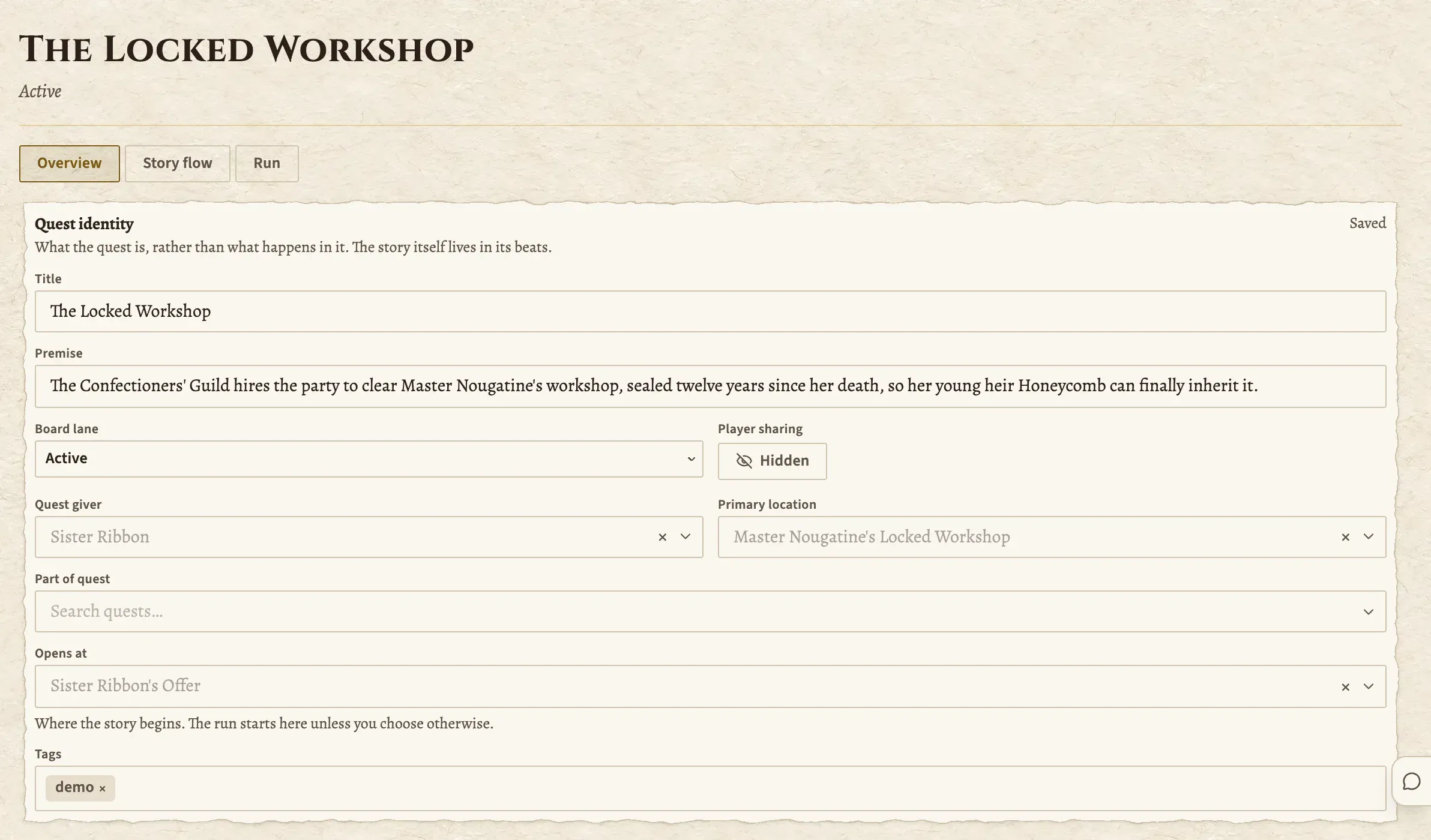
Two systems, one problem
- Objectives
- A quest is a set of steps, not a paragraph. Tick them off as the party actually does them.
- Who gave it
- Every thread is attached to the NPC who handed it over, so "who wanted this again" is one click.
- Rewards owed
- What was promised, by whom, and whether it's been paid. Debts survive the six-month gap.
- Linked to encounters
- A fight can advance a quest. Attach it when you build the encounter and the log keeps up.
- Faction standing
- Reputation that moves as the party meddles. The guild remembers. So does the app.
- Rivalries
- Factions relate to each other as well as to the party, which is what makes helping one of them cost something.
- The party's copy
- Players get the quest log in their portal, so nobody reopens a subplot you resolved in March.
- Notes on both
- You and your players can pin private or shared notes to any quest or faction.
WHY THEY SHARE A PAGE
A quest is a promise. A faction is who remembers you broke it.
Quests and factions are usually sold as separate features, and it's a strange split, because the interesting part of a quest is almost always who wanted it done and what it costs you with everyone else.
Help the Thieves' Guild and the City Watch notices. Take the noble house's money and the dockworkers stop talking to you. That's not a subsystem; that's the campaign. Keeping both in one place is what lets you answer "and what does that cost us?" without inventing it on the spot.
THE PART PLAYERS LOVE
Give them the log and watch them run the recap.
The single highest-value thing here is that your players get their own copy. The Journal tab in their portal lists what's open, who gave it and what's owed, and because they can read it on the bus, someone always turns up already knowing what the plan is.
They'll also stop asking you to re-explain the thing you resolved in March, because it's marked resolved, in writing, where they can see it. Everyone wins, including the guild that's still annoyed about the warehouse.
Questions a DM would actually ask
Why not just keep a list in my notes?
You can, and most of us did. The failure isn't the list. It's that a flat list doesn't tell you who's owed what, which threads point at the same NPC, or which of the eleven open items the party actually cares about. Structure is what makes it survive month four.
Do players see the quest log?
Yes, the Journal tab in the Player Portal. This is the feature that reclaims the first twenty minutes of a session, because "wait, what were we doing?" becomes something they answer among themselves before you've sat down.
Can they see quests I haven't given them?
No. What's in your log and not theirs stays yours. The thread you're seeding for three sessions' time doesn't appear until you hand it over.
How does faction reputation change?
You move it, deliberately, when the party does something that warrants it. It isn't a simulation running in the background. A number that drifts on its own would be a number you don't trust. It's a record of your rulings that everyone can see.
Do factions do anything, or are they just notes?
They're wired in: NPCs belong to them, encounters can involve them, and combatants take sides in the encounter runner. A faction is a thing the world is made of rather than a page you occasionally re-read.
What if my campaign is mostly one big story?
Then you'll have fewer, longer quests with more objectives, which works fine. The tracking earns its keep in proportion to how much your party forgets, which, in a two-year campaign, is quite a lot.
Reclaim the first twenty minutes.
Put your open threads somewhere your players can read them, and find out how much of the recap they'll do for you.
Open your grimoire for freeNo card. No beta waitlist. Always free for your players.
In the same grimoire
Workshop
Crafting and cooking with real recipes, components and downtime days, tracked by the app instead of audited by you.
Economy & Inventory
Real coins, self-sorting purses, carry weight, and a merchant who might be lying about the wand.
Portrait Gallery
Original painted-style art for every hero, NPC and villain, and one gallery holding all of it.
NPCs
The whole cast, with relationships, secrets, inventories and the note your player wrote about them.