
D&D GODS & PANTHEONS
Pantheon
Deities with domains, symbols and dogma, arranged into pantheons that make sense together and wired to the factions that worship them, which is where gods start affecting your campaign.
SESSION ZERO, EVERY TIME
"Who does your cleric worship?" And then a long pause.
It happens in almost every session zero. Someone builds a cleric or a paladin, asks a perfectly reasonable question about who they answer to, and the honest answer is that you hadn't thought about it, because gods felt like the part of worldbuilding you could defer.
What follows is usually a name invented on the spot that never comes up again, which is a waste, because divine conflict is one of the most reliable engines in fantasy. Two churches that disagree will generate more plot than any dungeon you can draw.
Pantheon is where the gods get written down properly: domains, symbols, dogma, and, crucially, the factions that worship them and fight about it.
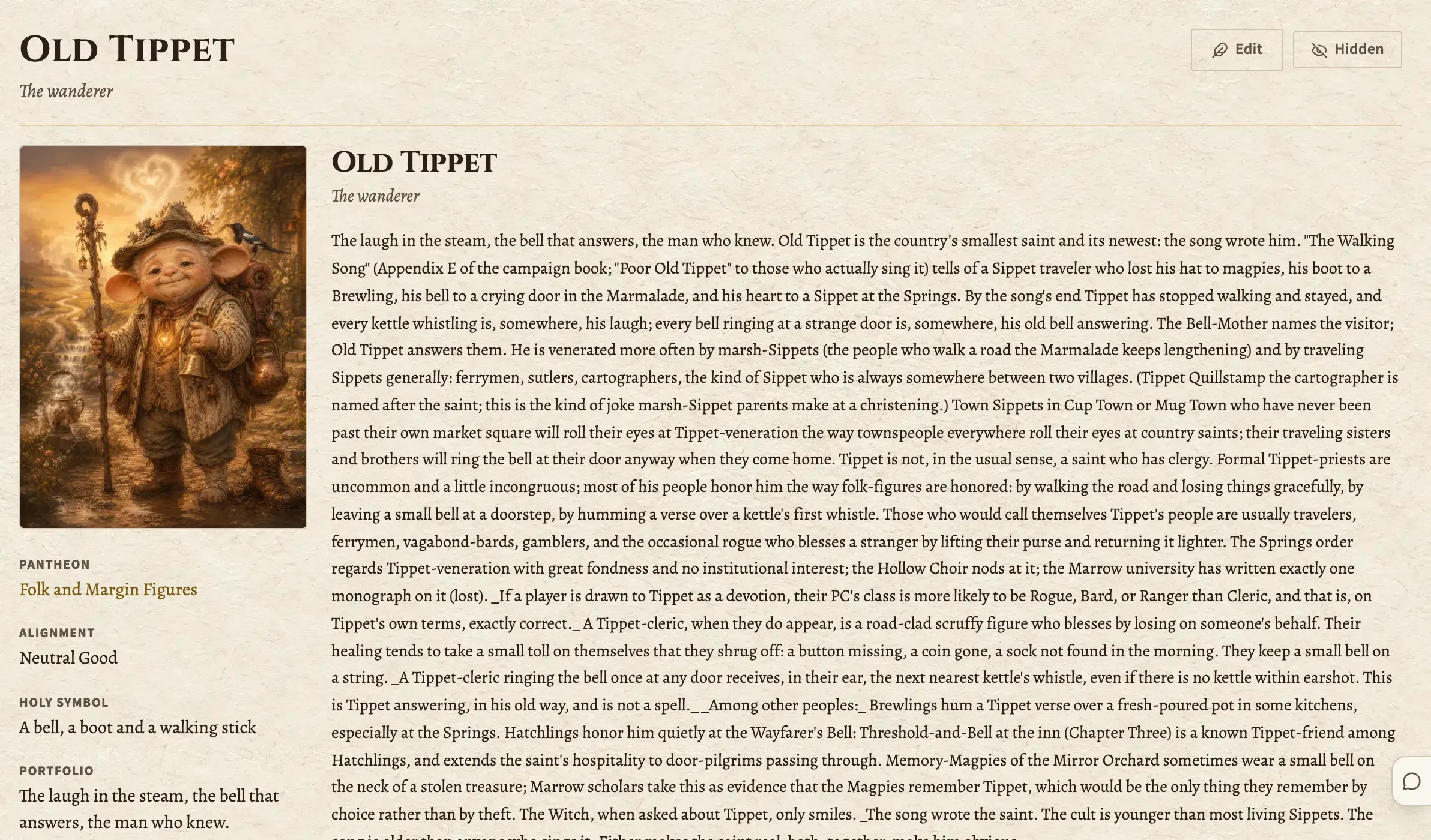
What a pantheon holds
- Deities
- Domains, symbol, alignment, dogma, and the portrait, because gods should have faces.
- Pantheons
- Gods grouped into the arrangement they belong to, with their own emblem.
- Wired to factions
- The church, the cult, the militant order. This is where a god starts affecting your campaign.
- Nine settings' worth
- Each shipped setting seeds its own gods, so Faerûn arrives with Faerûn's pantheon.
- Player-facing lore
- What the faithful know, in the party's portal. What's true stays with you.
- Cleric-ready
- Domains your players can actually pick when they build a cleric or paladin.
THE BIT THAT MAKES GODS REAL
A god without a church is trivia. A god with three churches is a campaign.
The reason most homebrew pantheons stay inert is that they're written as a list of names and domains, reference material with nothing to grab hold of. Nothing in a list of gods gives a party anything to do.
Link a deity to the factions that serve them and it changes character immediately. Now there's an orthodox church with money, a militant order with opinions about the party's cleric, and a splinter sect the orthodoxy would very much like dealt with quietly.
Questions a DM would actually ask
Do I need a pantheon if my campaign isn't about gods?
Probably not a detailed one, but you need more than you think the moment a player rolls a cleric and asks who they worship. Two paragraphs and a domain beats "uh, pick one from the book" at session zero.
How do gods connect to the rest of the campaign?
Through factions, which is the part that makes them matter. A god on their own is lore. A god with a church that owns land, a militant order with opinions, and a heretical splinter cult is a set of things the party can help, rob or annoy.
Do the shipped settings come with their pantheons?
Yes. Each of the nine settings seeds its own divine lore along with its calendar and locations. A Forgotten Realms campaign doesn't start with an empty pantheon and a wiki tab open.
Can players see the gods?
They see what the faithful would know: names, domains, symbols, public dogma. What's actually true about a god, and whether the church knows it, stays DM-side until you decide otherwise.
Can I build a pantheon from scratch?
Yes. Homebrew settings are the reason this is a builder and not a lookup table. Define your gods, their domains and dogma, and group them into whatever arrangement your world has, including the ones that hate each other.
What about domains for clerics?
A deity carries its domains, so a player building a cleric picks a god and gets a coherent answer about what they can do. It also means "what would my god think of this" has something to point at.
Have an answer ready before someone rolls a cleric.
One god, two domains, and a church that wants something. That's the whole ask.
Open your grimoire for freeNo card. No beta waitlist. Always free for your players.
In the same grimoire
Interlude
Downtime draws and the outcomes they spit out, so something actually happens in the week between adventures.
Party
Heroes, companions, death saves, conditions and XP: the DM's view of everyone at the table.
Notes
Session notes and lore that link to everything else, plus a chronicler that can write the recap for you.Session notes and lore that link to everything else, so last session is always one click away.